
Review request volume, token usage, latency, model mix, GPU utilization, and hosting architecture.
AI infrastructure optimization
Benchmark, optimize, and govern production AI infrastructure.
Cogniware.ai helps enterprises reduce inference waste, improve routing, raise utilization, and design controlled AI infrastructure across private, hybrid, and sovereign-ready deployments.
Hardware-flexible across leading accelerators



What we optimize
Optimize inference, from models to megawatts.
Practical techniques across software, hardware, networking, and data center strategy.
10levers
4system layers
1energy path
M
Modelroute, cache, benchmark
R
Runtimethroughput, accuracy
G
AcceleratorGPU utilization, fabric
F
Facilitycooling, power readiness
Measure
- Inference benchmarking
- Throughput tuning
Orchestrate
- Cache optimization
- Model routing
- Multi-model orchestration
Compute
- Dual-reasoning accuracy
- GPU utilization
Infrastructure
- 800G non-blocking fabric
- RDMA / RoCEv2 networking
Outcome: lower latency, higher utilization, clearer capacity planning, reduced energy waste.
How we measure savings
Optimization starts with a benchmark, not a slogan.
Savings targets depend on workload pattern, model choice, context size, routing design, deployment model, and infrastructure utilization.
Separate premium reasoning from extraction, classification, summarization, routing, and repetitive steps.
Apply caching, prompt/context discipline, batching, orchestration, and throughput tuning where appropriate.
Define metrics, fallback models, private deployment boundaries, and ongoing capacity review.
AI cost stack
Optimize every layer, from model to megawatt.
Cost compounds down the stack. Cogniware.ai finds practical savings at each layer, then aligns them into one optimized system, so spend falls without sacrificing performance.
Model, inference, GPU, data center, and energy, tuned together with azure-grade engineering: disciplined architecture, operational resilience, observability, and capacity planning.

Before / after
From over-provisioned to optimized.
Before optimization
- Over-provisioned GPU capacity
- High inference cost per request
- Power and cooling waste
- Unclear capacity planning
After optimization
- Optimized workload routing
- Higher GPU utilization
- Lower cost and energy draw
- Predictable capacity planning
How we help
Three ways Cogniware drives down cost.
Inference stack optimization
Benchmark current inference, then apply cache optimization, model routing, orchestration, and throughput tuning.
Neocloud data center design
Design AI-native facilities for high-density compute, resilient power, and liquid-cooling readiness.
Efficient AI middleware
Run multiple LLMs on a single device and raise utilization, with infrastructure cost reductions of up to 70% depending on workload and deployment assumptions.
Efficient middleware
Maximize the impact of every GPU.
Cogniware middleware optimizes how GenAI systems use compute, so you can run multiple LLMs on one device, raise hardware utilization, and reduce infrastructure cost by up to 70% where workload and deployment assumptions support it.
Dual-reasoning, multi-model inference improves accuracy and reduces hallucinations through intelligent model routing and orchestration.

Neocloud design
Engineer for high-density AI compute.
We design AI-native data centers built for density, resiliency, and performance, with advanced power engineering and progressive liquid-cooling readiness.
Non-blocking 800G fabric, RDMA/RoCEv2, and flexible NVIDIA, AMD, and Intel support, from sovereign AI environments to commissioning and operations.

Our impact
Less waste. Less power. Fewer facilities.
Higher utilizationOptimize compute utilization for demanding AI workloads.
Lower power drawCut the power needed for compute and cooling.
Less build-outReduce the need to build additional data center capacity.
Sovereign and private AI
Data residency is a regulatory requirement in the GCC, not a preference.
Saudi PDPL, UAE federal privacy legislation, and Qatar's data protection framework mean organizations in financial services, healthcare, and government cannot send regulated data to global cloud providers without specific controls in place.
Saudi Arabia — PDPL
The Personal Data Protection Law requires sensitive personal data to be processed within Saudi Arabia's borders. SAMA regulatory oversight adds AI governance requirements for financial data. Cogniware.ai supports private and on-premise deployments that keep data within the Kingdom.
UAE — Privacy Legislation and AI Strategy
The UAE's federal data protection law and AI Strategy 2031 are driving demand for UAE-hosted AI infrastructure. The UAE Cabinet approved an agentic AI framework requiring accountability and audit trails for AI decisions.
Across the GCC — Sovereignty by Design
Gartner recorded a 305% increase in cloud sovereignty inquiries in H1 2025. Building AI infrastructure with sovereignty controls from the start is less expensive than retrofitting compliance after an incident.
How an engagement works
From first conversation to optimized infrastructure.
Every engagement starts with a cost and utilization assessment. We do not prescribe solutions before we understand the baseline.
We review current AI workloads, token usage, GPU utilization, model mix, hosting architecture, and cost structure. You receive a baseline report with identified optimization opportunities.
We map which workloads should move to which model tier, where batching and caching apply, and what routing changes reduce cost without affecting quality.
We implement the Cogniware.ai middleware and optimization changes, benchmark throughput and cost after each change, and document the delta against baseline.
We set up utilization dashboards, cost attribution, anomaly alerts, and a quarterly capacity review cadence so optimization is maintained as workloads evolve.
What you receive: Baseline cost and utilization report · Optimization recommendations · Implementation with before/after benchmarks · FinOps dashboard · Ongoing review cadence
What we need from you: Access to current AI workload metrics or API billing data · Infrastructure architecture overview · Named technical contact for coordination
Plain language
Key infrastructure terms explained for non-technical readers.
GPU utilization
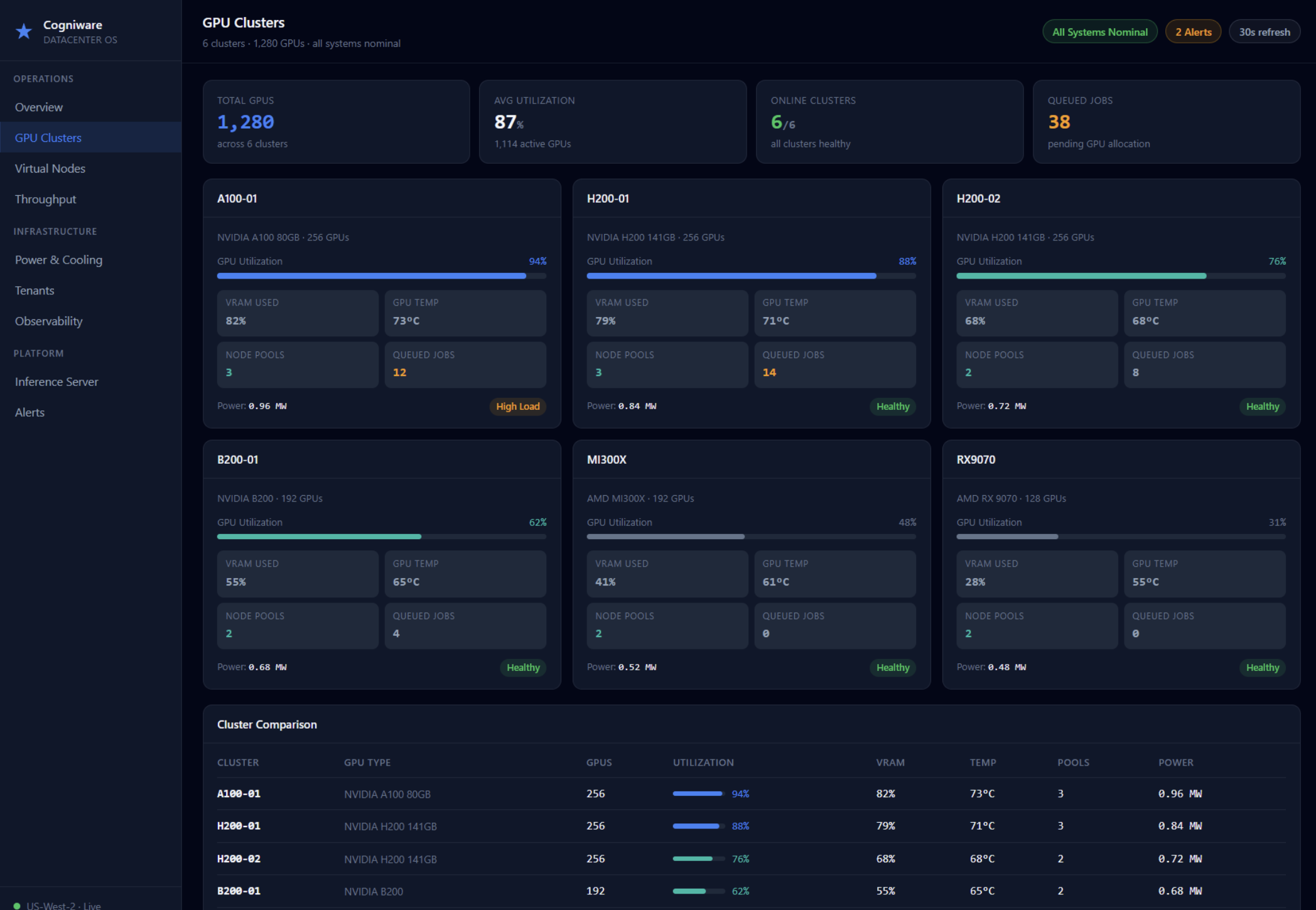
The percentage of a GPU's processing capacity actively being used. A GPU at 30% utilization is idle 70% of the time — you are paying for capacity you are not using. The optimization target is 60–80% sustained utilization.
Inference
The process of running an AI model to produce an output. Training teaches the model; inference is the work it does after training. Most enterprise AI cost is inference cost, not training cost.
Model routing
Directing different AI requests to different models based on complexity. A simple classification task does not need the same model as complex legal analysis. Routing smaller tasks to smaller models reduces cost without reducing output quality where it matters.
Inference batching
Grouping multiple AI requests together and processing them simultaneously. Batching raises GPU utilization and reduces cost per request by 30–40% for workloads that do not require real-time responses.
800G non-blocking fabric
A high-speed network interconnect that allows multiple GPU servers to communicate without bottlenecks. Critical for large AI models spanning multiple GPUs. "Non-blocking" means no traffic queuing under high load.
Sovereign AI
AI infrastructure deployed within a country's own legal and geographic boundaries, keeping data and processing under local regulatory control. Required by Saudi PDPL, UAE privacy legislation, Qatar's data protection framework, and sector regulators like SAMA and CBUAE.
FAQ
Practical questions before production scale.
No. It is an approved upper-bound claim for suitable workloads. Actual savings depend on baseline waste, routing options, model mix, throughput, and deployment choices.
Yes. Architecture can be shaped around private, hybrid, and controlled inference patterns where selected models and infrastructure permit it.
Hybrid routing and model independence reduce single-provider dependency and create fallback options for business-critical workflows.
Start with one workload, cost baseline, latency requirement, data boundary, and target deployment model.
Review AI spend
Find the inference waste before production scale multiplies it.
We can review your current AI workloads, routing patterns, and infrastructure choices, then identify where Cogniware.ai can improve cost, resilience, and control.