
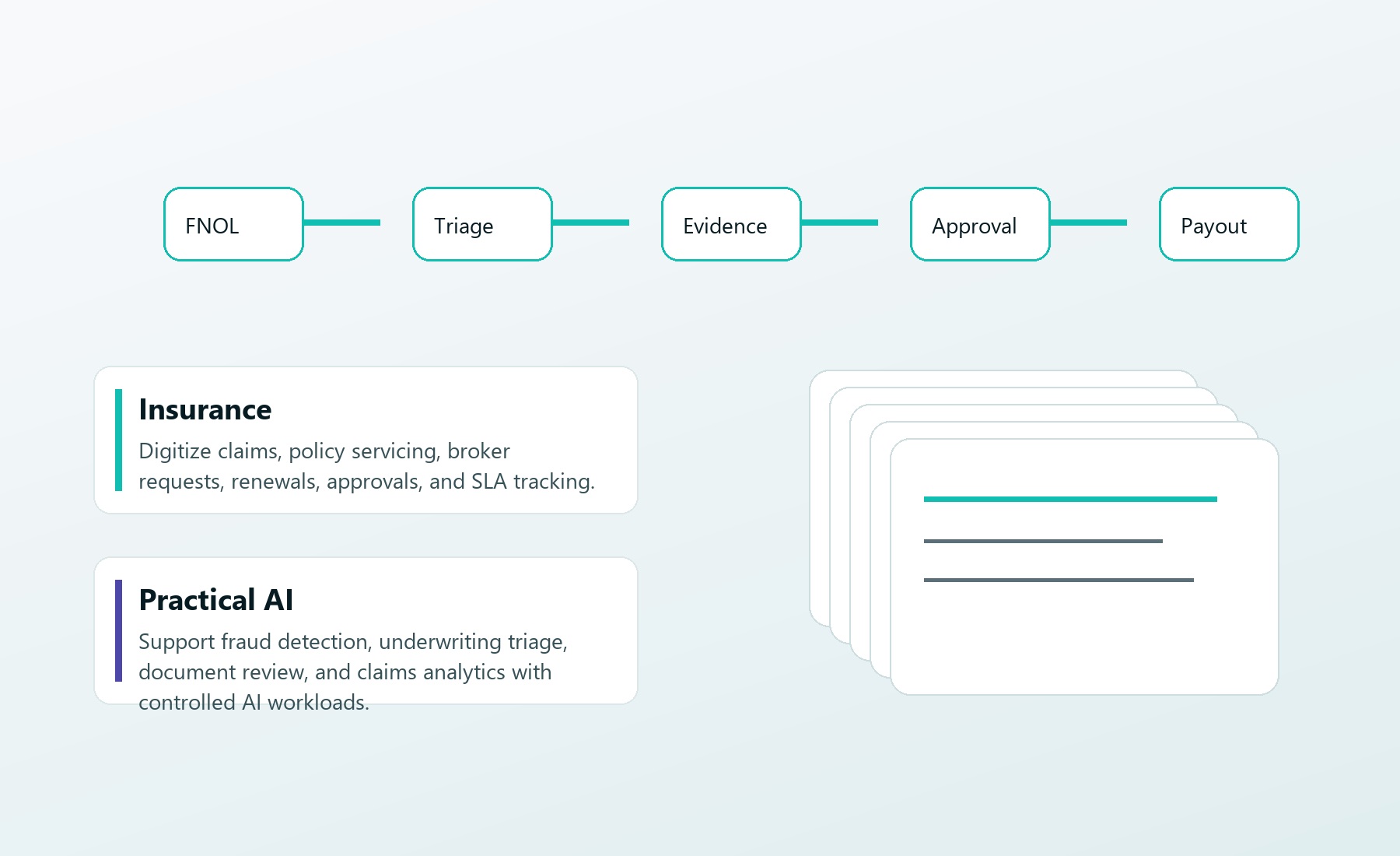
Capture first notice of loss, route evidence, assign adjusters, manage vendors, and track claim SLAs end to end.
Industry
Insurance workflows with clearer control.
Insurers use in-box.ai to digitize documents, decisions, and handoffs across the policy lifecycle, while keeping AI-enabled claims and underwriting workloads efficient enough to scale.
Coordinate risk reviews, quote referrals, missing-information requests, broker follow-up, and authority limits.
Use AI for extraction, summarization, fraud signals, and underwriting analytics without letting inference cost drift.
Operating model
Move standard cases through quickly and keep exceptions visible.
Claims lifecycle
Replace scattered follow-up with structured task routing, evidence capture, approval paths, and settlement ownership.
Broker and customer service
Give service teams a reliable view of status, bottlenecks, next actions, and the people accountable for each step.
Rules that can change
Let business teams adjust workflow rules, products, and referral paths without waiting for long release cycles.
Business value
Reduce cycle time while improving control and visibility.
- Faster claims resolutionMove standard claims through clear task routing and focus expert attention on exceptions.
- Stronger service experienceGive brokers, members, and customers clearer answers about status and next steps.
- Scalable AI economicsKeep document, fraud, and underwriting workloads cost-effective as adoption expands.
First workflow
Start with claims triage or underwriting referrals.
Claims intake and assignment
Capture first notice of loss, documents, photos, policy details, coverage checks, adjuster assignment, vendor tasks, and settlement approvals in one workflow.
Document AI with review controls
Use AI to support extraction, summarization, and fraud signals while keeping accuracy thresholds, exceptions, and human review steps visible.
Broker and customer visibility
Give service teams a reliable status layer so brokers, members, and customers get clearer answers without repeated manual follow-up.
FAQ
Insurance questions we expect early.
How accurate is the document and claims AI?
Extraction and summarization are grounded in approved sources, with human review on exceptions and validation before production.
Can business teams change rules without long release cycles?
They can when rules, products, and referral paths are modeled as governed configuration with clear ownership and release controls.
Does AI cost stay under control as volume grows?
Cost control requires workload measurement, model routing, context limits, and inference tuning before document, fraud, and underwriting usage scales.
Can claims and policyholder data stay within required boundaries?
Deployment and data-residency options can keep sensitive data controlled when the boundary requirements are defined at the start.
Regional context
Insurance AI in the GCC: fraud detection, claims automation, and regulatory compliance.
GCC insurers are under pressure to improve claims speed, fraud review, and digital servicing without weakening governance
Fraud detection AI is most useful when investigators can see evidence, confidence, and escalation history
No-code workflow platforms can shorten claims-cycle experiments when the process owner, exception paths, and integration needs are clear
Relevant frameworks and regulators
SAMA InsuranceSaudi Arabia — regulates AI use in motor, medical, and life insurance products
Insurance Authority UAENow part of CBUAE — regulates AI in UAE insurance products and claims
JIC JordanJordan Insurance Commission — oversees insurance sector technology governance
PDPL and UAE data lawCustomer personal and health data used in AI underwriting and fraud models must comply with residency requirements
Start focused
Move one claims or underwriting bottleneck into governed execution.
We'll help you scope a first workflow across the policy lifecycle with clear ownership and scalable AI economics.