
Permits, licenses, inspections, grants, complaints, appointments, and service-status communication in one workflow layer.
Industry
Public services with governed AI.
Government entities use in-box.ai to digitize citizen services, internal approvals, and case management while designing AI workloads around data boundaries, infrastructure control, and measurable public value.
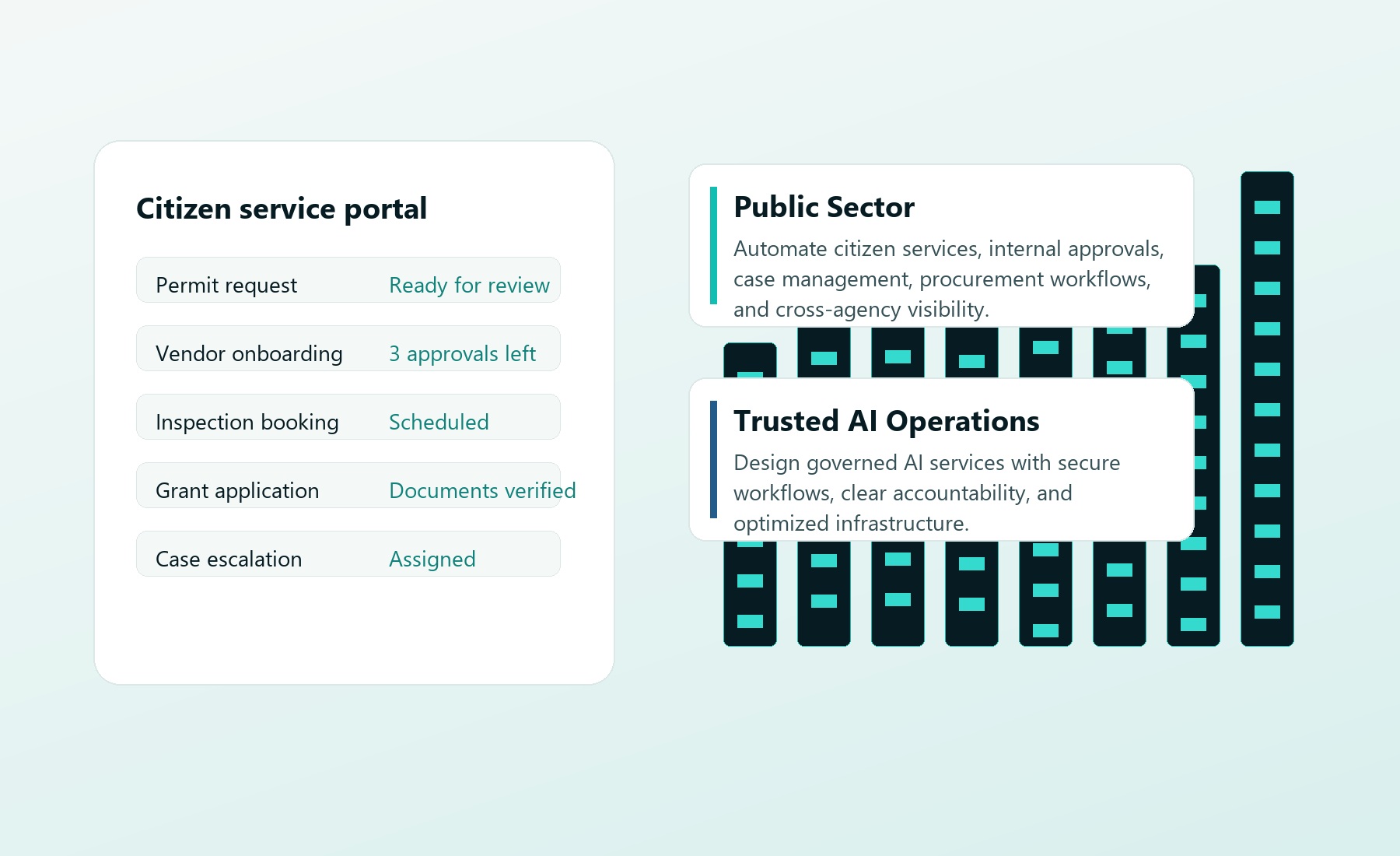
Procurement, vendor onboarding, budget approvals, HR services, assets, and committee actions with clear ownership.
Knowledge search, case summarization, and service assistance designed around residency, policy, and deployment control.
Citizen journey
Digitize one service journey without weakening policy control.
Request intake
Capture citizen, business, or employee requests with structured forms, required evidence, and bilingual readiness.
Review and routing
Route cases across departments, committees, field teams, and policy owners with SLA and escalation visibility.
Sovereign AI support
Use AI for search, summarization, and assistance while respecting data residency and controlled deployment choices.
Business value
Deliver faster services with better accountability.
- Less manual administrationReduce email follow-up, spreadsheet tracking, paper forms, and unclear ownership.
- Transparent service deliveryTrack request status, SLAs, escalations, and department handoffs in real time.
- AI that can be governedBuild adoption around workflow controls, data boundaries, infrastructure control, and public value.
First workflow
Start with one high-volume service journey.
Service request control room
Choose one citizen, business, or employee service with visible backlog pressure, then map intake, evidence, routing, SLA, approvals, and closure into a governed workflow.
Policy and residency guardrails
Separate workflow data, AI assistance, and reporting requirements so teams know what can run in cloud, private, or on-premises patterns before scale decisions are made.
Operational handover
Launch with named service owners, escalation paths, reporting views, and change ownership so the workflow becomes a reusable public-service pattern.
FAQ
Public-sector questions we expect early.
Can citizen and case data stay inside national boundaries?
Architecture can support data residency, private or on-premises deployment, and controlled inference when the approved hosting and data-handling boundaries are defined early.
Do we have to move to the cloud?
No. Workflows and AI can run on-premises, in a private cloud, or hybrid, depending on policy.
How does this fit public procurement?
Engagements start with one scoped, bounded service so cost and value are clear before any larger commitment, and platform choices stay transparent and portable.
Can our own teams operate it after launch?
That is the goal. Documentation, training, and admin handover should be part of delivery so the agency is not dependent on external changes for every workflow update.
Regional context
Public sector AI in the GCC: national strategies, procurement rules, and sovereignty requirements.
Saudi Arabia declared 2026 the Year of Artificial Intelligence; SDAIA leads national AI implementation across government entities
UAE Cabinet approved an agentic AI framework for all ministries; 80,000 public-sector workers are being trained in AI
GCC government procurement AI is reducing RFQ creation time by 50% and tendering cycles by 70% in early deployments (JAGGAER, 2025)
Relevant frameworks and regulators
SDAIA Saudi ArabiaSaudi Data and Artificial Intelligence Authority — sets AI governance standards for all government entities
TDRA UAETelecommunications and Digital Government Regulatory Authority — governs digital government AI
PDPL and UAE Privacy LawGovernment entities must comply with personal data protection requirements when using AI on citizen data
Data sovereignty requirementsGovernment AI must run on locally hosted or approved-sovereign infrastructure in both Saudi Arabia and the UAE
Start focused
Modernize one public service without losing policy control.
We'll help you choose a first citizen or internal-approval workflow, define ownership and data boundaries, and prove value before scaling.