
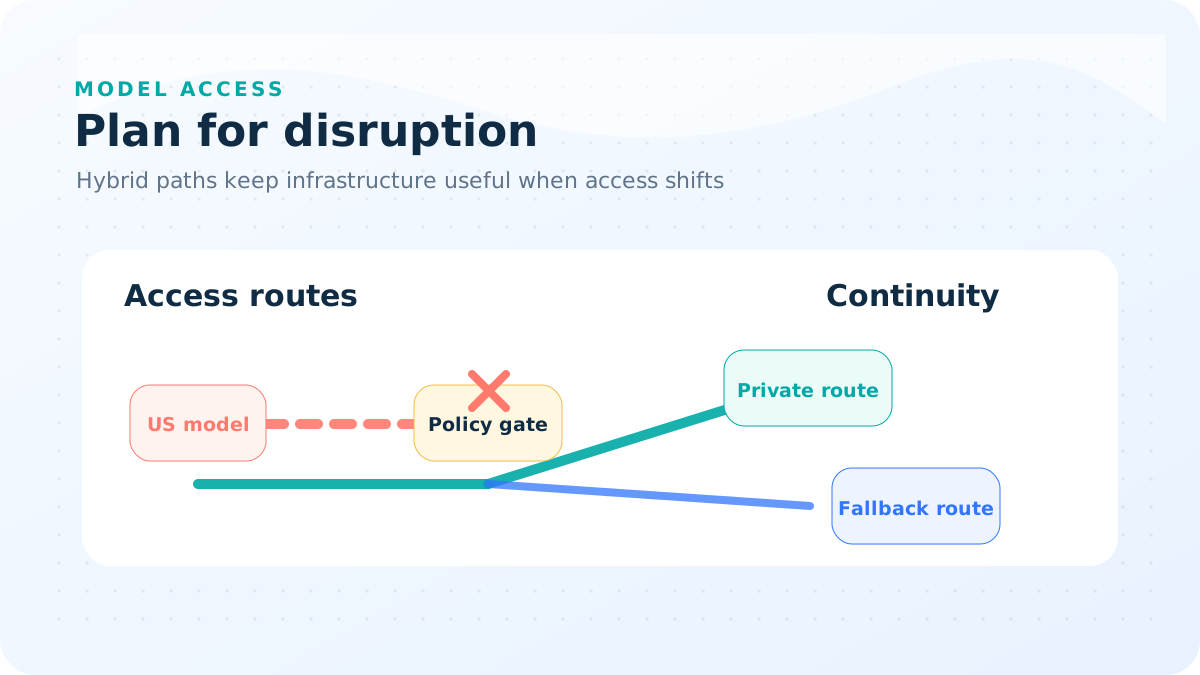
In June 2026, Anthropic announced that the U.S. government issued an export control directive suspending all access to Fable 5 and Mythos 5 — requiring the company to disable those models for all customers globally while other Anthropic models remained available. In September 2025, Anthropic strengthened regional sales restrictions, prohibiting access by organizations subject to control from jurisdictions where its products are not permitted, regardless of where those entities operate.
These are not isolated vendor decisions. They sit inside a broader U.S. policy environment. The Commerce Department's Bureau of Industry and Security rescinded the Biden-era AI Diffusion Rule in May 2025 while issuing new guidance on advanced computing chip diversion and AI model weight controls. The January 2025 Framework for Artificial Intelligence Diffusion proposed tiered global access to advanced AI models and computing capacity.
For CIOs and CISOs in the UAE, Saudi Arabia, Qatar, and across the GCC, the pattern is clear: model access is a policy variable, not a procurement constant.
A shifting control environment
Three policy threads converge.
Chip export controls. BIS continues to tighten controls on advanced computing integrated circuits and related items, with May 2025 actions including guidance on Huawei Ascend chips and warnings about U.S. AI chips used to train Chinese AI models. Compute access and model access are linked — restricted chips constrain sovereign training and fine-tuning options.
Model weight diffusion rules. The January 2025 AI Diffusion Rule framework proposed licensing requirements for advanced closed-weight models and restrictions based on country tier. While the rule was rescinded before full enforcement, it established a precedent: frontier model weights can be treated as export-controlled items.
Vendor-directed access changes. Anthropic's Fable 5 and Mythos 5 suspension demonstrates that even allied-region enterprises can experience abrupt model unavailability when national security authorities intervene. Regional sales restrictions add ownership-structure tests that affect multinational entities with complex corporate trees — common in Middle East banking and government contracting.
The UAE has secured advanced semiconductor access through bilateral partnerships, including reported U.S. approval for G42's Abu Dhabi AI campus expansion. Saudi Arabia is building AI hubs through PIF partnerships with Google Cloud and Qualcomm/HUMAIN. National-level access does not automatically extend to every enterprise API agreement or every model tier.
Why single-vendor AI stacks are a continuity risk
Most Middle East enterprises still run production pilots on a single frontier API. Architecture diagrams show one provider, one model family, one billing relationship. Operational runbooks rarely document fallback behavior.
When a model is suspended, terms change, or export policy shifts, these organizations face:
- Service interruption for workflows hard-coded to a specific model endpoint
- Re-engineering cost to retest prompts, agents, and safety controls on alternate models
- Compliance exposure if sensitive data was processed under terms that changed retroactively
- Procurement delay while legal reviews new vendor agreements under PDPL and sector rules
Gartner's observation that only about 48% of AI projects reach production — with an average eight-month prototype-to-production timeline — suggests most organizations are still brittle at the model layer. Export control volatility will punish that brittleness.
Hybrid model routing as resilience architecture
Resilience does not mean avoiding U.S. or global frontier models. It means ensuring no single model suspension halts business operations.
Cogniware.ai provides the routing and abstraction layer Middle East enterprises need:
- Multi-model orchestration across approved frontier APIs, open-weight models, and private deployments
- Policy-based routing that directs workloads by sensitivity, language, cost, and availability
- Failover logic that shifts tasks to alternate models when endpoints are degraded or unavailable
- Private inference options for workloads that must continue regardless of external API policy
- Cost and usage observability to compare unit economics across providers as procurement renegotiates
The objective is not model agnosticism for its own sake. It is business continuity with measurable quality and cost guardrails — the same standard applied to core banking and ERP systems.
Middle East-specific considerations
Regulated sectors — central banks, insurers, government shared services — cannot tolerate unplanned AI outages in customer-facing or supervisory workflows. The UAE Central Bank's February 2026 AI/ML guidance for licensed financial institutions expects kill-switch capability and board-level accountability. An export control suspension is precisely the scenario kill-switch and failover architecture must address.
Saudi PDPL localization requirements may limit which foreign-hosted models can process personal data without additional safeguards. Hybrid routing must respect data classification, not only availability.
National sovereign AI investments create opportunity. Organizations that route intelligently can use local and hybrid capacity for high-volume workloads while reserving frontier APIs for specialized tasks — reducing both exposure and cost.
What this means for leaders
- Model access is a geopolitical and regulatory risk category. Include it in enterprise risk registers alongside cyber and third-party concentration.
- Prohibit production deployments that lack a documented fallback model and retest procedure.
- Separate workflow logic from model endpoints so provider changes do not require process rewrites.
- Negotiate contracts with explicit change-of-terms and service-suspension clauses reviewed by legal and data protection teams.
- Invest in private or open-weight inference capacity for continuity-critical workloads, not only for cost optimization.
Practical action checklist
- Catalog every production AI workflow by model provider, model version, and data classification.
- Define Tier 1 (must not fail) workflows and require Cogniware.ai failover routing for each.
- Run quarterly tabletop exercises simulating model suspension or API termination.
- Maintain a pre-approved alternate model list with completed safety and quality retesting.
- Document data processing implications of each routing path under PDPL and sector guidance.
- Track BIS export control updates and provider policy changes in a shared governance calendar.
- Report model concentration risk to the board alongside cloud and core vendor concentration metrics.
Build for disruption, not surprise
The Fable 5 and Mythos 5 suspension is a reminder that frontier AI is both a capability and a controlled technology. Middle East enterprises investing billions in digital transformation cannot anchor critical workflows to a single point of policy failure.
Cogniware.ai gives organizations hybrid model routing, private inference options, and the operational visibility to absorb the next disruption without emergency re-architecture.
in-box.ai helps GCC enterprises deploy Cogniware.ai as part of a controlled, sovereign-aware AI infrastructure strategy built for long-term resilience.
Sources used
- Anthropic — Statement on US government directive to suspend Fable 5 and Mythos 5 access (June 2026)
- Anthropic — Updating restrictions of sales to unsupported regions (September 2025)
- BIS — Rescission of AI Diffusion Rule; strengthened chip export controls (May 2025)
- Federal Register — Framework for Artificial Intelligence Diffusion (January 2025)
- Sidley Austin — New US export controls on advanced computing and AI model weights (January 2025)
- Crowell & Moring — Middle East AI investment and US-UAE semiconductor partnership context
- Gartner — 48% of AI projects reach production; eight-month average timeline (cited via Informatica)
AI briefings
Get the next practical AI and automation briefing
Practical notes on workflow automation, AI infrastructure economics, and governed AI adoption across the Middle East.