
Saudi Arabia's Vision 2030 framework places digital transformation at the center of economic diversification. The U.S. International Trade Administration reports that the Kingdom's ICT sector was valued at nearly $48 billion as of May 2025, with AI spending projected to surpass $800 million in 2025 and reach $2.1 billion by 2027. The UAE's National Strategy for Artificial Intelligence 2031 targets global leadership in AI, backed by federal charters, ethics frameworks, and major infrastructure partnerships.
Timelines are not abstract. Government digital strategies, Cloud First policies, and sector modernization programs create delivery pressure measured in quarters, not years. Yet traditional enterprise software procurement — multi-year ERP extensions, custom BPM implementations, and SI-led transformation programs — routinely runs 12 to 24 months before a single approval workflow goes live.
The bottleneck is not AI models. It is operational workflow digitization.
National urgency meets enterprise inertia
Saudi Arabia's Digital Government Authority and SDAIA are driving AI and data governance across public entities. The UAE has appointed dedicated AI leadership at the federal level and enacted ethical AI charters. Qatar's central bank issued mandatory AI guidelines for financial institutions in 2024. Across the GCC, regulators and national programs are aligned on outcomes: faster services, measurable efficiency, and accountable digitization.
Inside enterprises and ministries, the constraint is different. Core systems of record — ERP, core banking, case management — are difficult to change. But the workflows around them — approvals, exceptions, inter-department handoffs, vendor onboarding, permit processing — still run on email, PDFs, and spreadsheets.
MIT NANDA research found that back-office automation delivers among the highest generative AI returns, yet most organizational spend targets front-office pilots. The GCC version of this mismatch is national AI ambition paired with unchanged approval chains.
Why vendor dependency slows transformation
Large platform vendors offer AI features inside existing suites. That path has three costs Middle East organizations are hitting in 2026:
Implementation latency. Customizing enterprise suites for local approval hierarchies, Arabic/English bilingual flows, and sector-specific controls extends timelines. Government entities under performance mandates cannot wait for the next major release cycle.
License coupling. AI and automation capabilities bundled into platform renewals reduce procurement flexibility. When national data localization or sector guidance changes, renegotiating a suite is slower than reconfiguring a workflow layer.
Process rigidity. Hard-coded BPM implementations require developer cycles for every policy change. Regulatory updates — such as evolving AI governance guidance from SDAIA or the UAE Central Bank — need rapid workflow adjustment, not change requests.
The alternative is not shadow IT. It is a governed no-code layer that digitizes processes quickly while integrating with systems of record.
Workhall: speed without sacrificing control
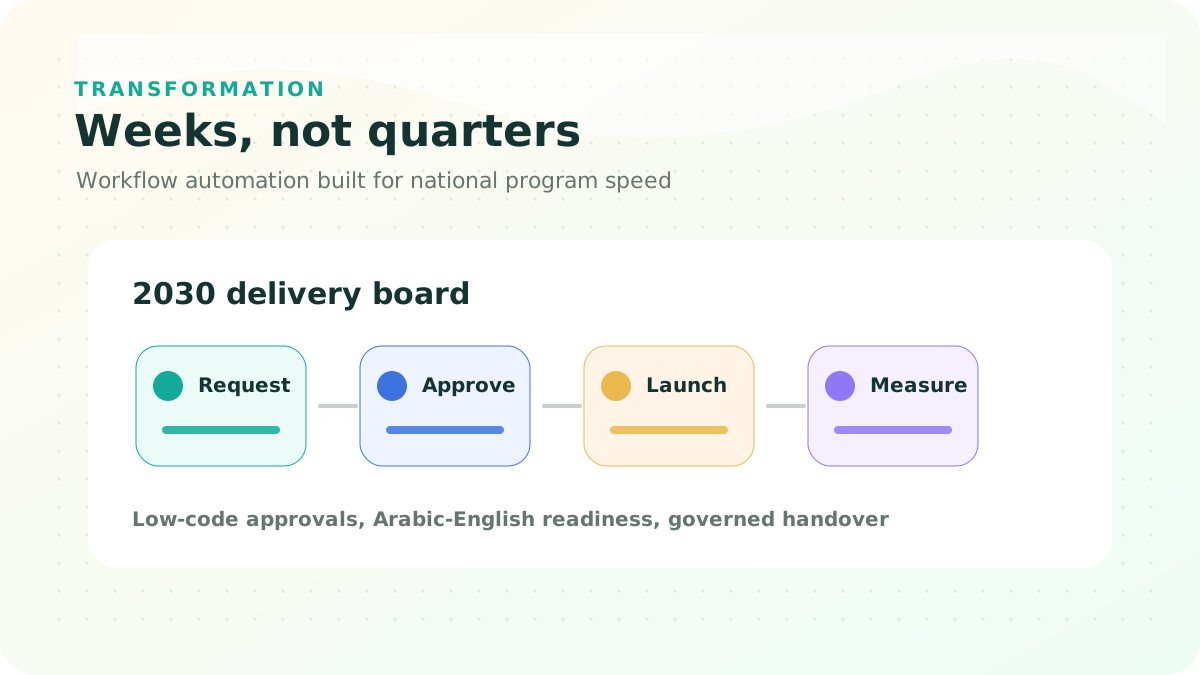
Workhall addresses the workflow automation gap directly. It enables organizations to build no-code business applications, approval workflows, and digitized processes in weeks rather than quarters — without replacing core ERP or banking platforms.
For Saudi and UAE organizations under Vision 2030 and national AI program timelines, Workhall delivers:
- Rapid process digitization for approvals, case routing, inspections, and service requests
- Configurable governance with role-based access, audit trails, and human-in-the-loop checkpoints aligned to emerging AI guidance
- Integration flexibility that connects to existing systems rather than rip-and-replace
- Reduced vendor lock-in because process logic lives in configurable applications, not proprietary codebases tied to a single hyperscaler
AI outputs become operationally useful when they land inside a governed workflow — a loan exception review, a procurement approval, a government service case — not when they appear in a standalone chat interface.
Where Workhall fits national programs
Government shared services. Digitize inter-entity approvals, budget releases, and citizen service escalation paths with measurable SLAs.
Banking and insurance. Build compliant approval chains for credit, claims, and KYC exceptions with documented human review — consistent with supervisory expectations on AI accountability.
Energy and utilities. Route capital expenditure approvals, vendor qualification, and field service exceptions without waiting for ERP customization backlogs.
Healthcare administration. Accelerate referral approvals, prior authorization workflows, and internal compliance reviews.
In each case, the value is time-to-production for the process — the metric national transformation programs actually track.
What this means for leaders
- National AI strategy succeeds or fails on workflow digitization velocity, not model selection alone.
- Prioritize no-code automation for high-volume approval and case management processes before funding additional copilot pilots.
- Evaluate vendor proposals on weeks-to-live for a production workflow, not feature roadmaps.
- Keep process logic portable; avoid architectures where workflow definitions are trapped in a single cloud suite.
- Measure automation programs by cycle time, error rate, and audit completeness — metrics regulators and transformation offices understand.
Practical action checklist
- Identify the top 10 approval-heavy processes still running on email or paper across the organization.
- Baseline current cycle time, rework rate, and compliance findings for each process.
- Deploy Workhall pilot applications for the three highest-volume processes within a 30-day window.
- Integrate Workhall workflows with existing systems of record via API — no core platform replacement.
- Assign business process owners, not only IT owners, to each digitized workflow.
- Document audit trails and approval hierarchies to align with SDAIA, PDPL, and sector guidance.
- Scale successful workflows horizontally before procuring additional AI model capacity.
Transformation runs on process speed
Vision 2030 and the UAE's AI 2031 strategy describe economies built on digital services, AI-enabled government, and diversified industry. None of that is achievable if approvals still take weeks because the workflow was never digitized.
Workhall gives Middle East enterprises and government entities a practical path to faster automation — without the vendor dependency and implementation cycles that have stalled prior transformation waves.
in-box.ai delivers Workhall as part of its enterprise automation practice for GCC organizations that need production workflows on national program timelines.
Sources used
- U.S. International Trade Administration — Saudi Arabia Digital Economy
- Saudi Vision 2030 — National Transformation Program
- UAE — National Strategy for Artificial Intelligence 2031
- Law Library of Congress — FALQs: AI Regulations in GCC (UAE and Saudi frameworks)
- Fortune — MIT NANDA research on back-office automation ROI
- Qatar Central Bank — AI Guidelines for licensed financial institutions (September 2024) (referenced via Crowell client alert)
AI briefings
Get the next practical AI and automation briefing
Practical notes on workflow automation, AI infrastructure economics, and governed AI adoption across the Middle East.