
The enterprise AI landscape in 2026 is defined by two uncomfortable statistics. MIT NANDA research found that roughly 95% of generative AI pilots fail to deliver measurable P&L impact. Gartner predicts at least 30% of generative AI projects will be abandoned after proof of concept by the end of 2025, and over 40% of agentic AI projects will be canceled by the end of 2027.
At the same time, aggregate AI spend is rising — not falling. Menlo Ventures reported $13.8 billion in enterprise generative AI spending in 2024, a sharp increase from prior years. McKinsey's 2024 global AI survey found 72% of organizations using AI in at least one business function. More adoption. More abandonment. Higher total cost.
Middle East enterprises are not exempt. Gartner forecasts MENA IT spending will reach $169 billion in 2026, with AI a growing share. Banks, government entities, and energy companies are closing the pilot phase and confronting a choice: scale with control, or fund a growing graveyard of experiments.
Anatomy of the pilot graveyard
Failed pilots share structural causes, not bad luck.
No production economics. Teams model license costs but not token volume at scale. Industry analyses describe inference consuming roughly 80% of production AI spend. A pilot that ignores per-workflow token math will be canceled when finance sees the first production invoice.
No workflow anchor. MIT's research shows vendor-led, workflow-integrated implementations succeed about 67% of the time; internal builds succeed roughly 33%. Pilots that generate text without changing approval chains, case statuses, or SLA metrics have nothing to measure.
No governance path. Gartner cites inadequate risk controls as a top reason for project abandonment. In the GCC, PDPL localization, sector AI guidance, and procurement ethics requirements mean a pilot without a compliance story cannot enter production.
Agentic cost escalation. Gartner expects agentic AI project cancellations to exceed 40% by 2027 as multi-step agent pipelines multiply inference calls without proportional value. Agent sprawl is the 2026 version of cloud sprawl.
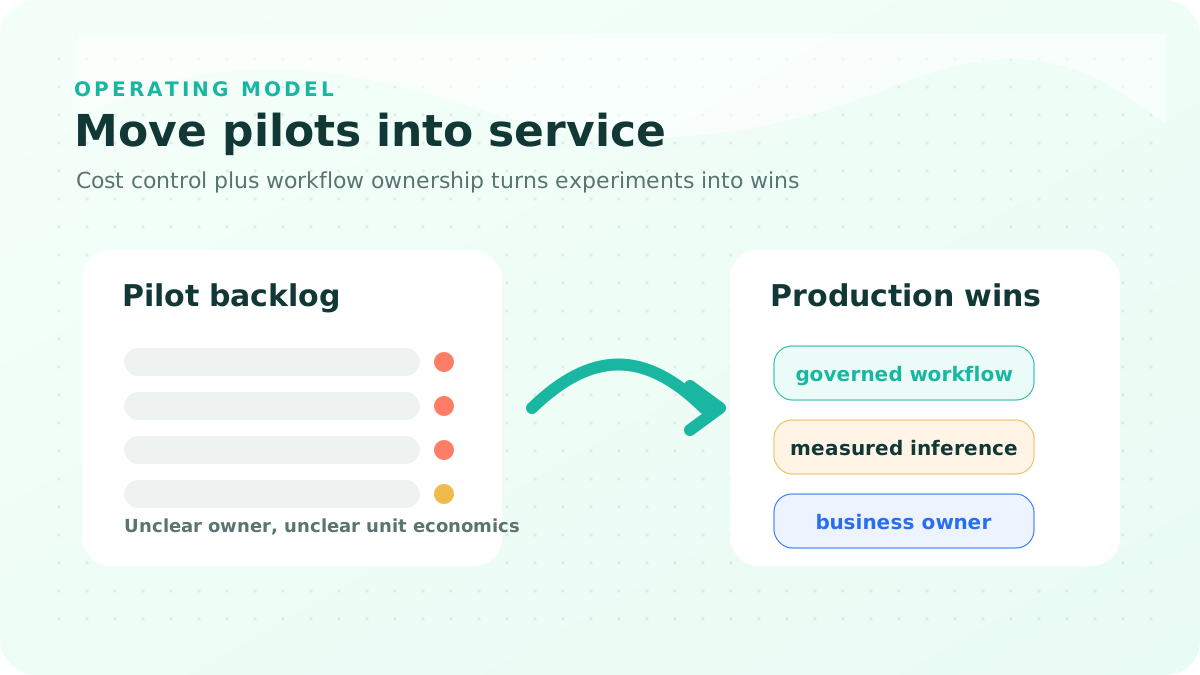
The pilot graveyard is not a technology failure. It is a control failure — over inference spend, workflow integration, and operating model discipline.
Taking back control: two layers, one operating model
Production wins require enterprises to take back control at two layers simultaneously.
Layer 1: Inference and model economics (Cogniware.ai)
Organizations must own their inference strategy — not necessarily their data center, but their routing, cost attribution, deployment choices, and failover logic.
Cogniware.ai enables:
- Model routing by task sensitivity, language, and cost
- Private and hybrid deployment for workloads constrained by data residency
- Token observability with chargeback to business units
- Failover across providers when access or policy changes
This is how finance regains predictability and technology regains optionality.
Layer 2: Workflow and process outcomes (Workhall)
Cost control without operational value still produces a canceled project. Workhall digitizes the approvals, case management, and business applications that turn AI output into completed work.
Workhall enables:
- No-code workflow and approval applications deployed in weeks
- Human-in-the-loop controls required by emerging GCC financial and government guidance
- Audit trails and process metrics that satisfy regulators and transformation offices
- Integration with systems of record without multi-year ERP projects
This is how operations regains measurable outcomes.
Combined operating model
The organizations escaping the pilot graveyard connect both layers. An AI-generated recommendation triggers a Workhall approval task. Cogniware.ai routes the inference call to the right model at the right cost. The workflow closes with a timestamped audit record. Finance sees cost per completed case. Operations sees cycle time reduction. Risk sees human oversight.
That is a production win — not a demo.
GCC context: why control matters now
Saudi Arabia designated 2026 as the Year of AI, with SDAIA leading national governance. The UAE Central Bank issued AI/ML guidance for licensed financial institutions in February 2026. Bahrain's proposed AI law includes licensing and penalty frameworks. The regulatory and national program environment rewards organizations that can demonstrate controlled production systems — not experiment volume.
U.S. export control actions — including the June 2026 suspension of Anthropic's Fable 5 and Mythos 5 — reinforce that model access is not guaranteed. Control means architectural resilience, not optimism.
What this means for leaders
- Stop funding new pilots without a production control plan covering inference economics, workflow integration, and governance.
- Consolidate AI spend around use cases with named process owners and baseline operational metrics.
- Implement Cogniware.ai and Workhall as complementary control layers — cost at the inference layer, value at the workflow layer.
- Kill agentic experiments that cannot articulate cost per successful outcome.
- Report to boards on production workflows completed, not pilots launched.
Practical action checklist
- Publish a pilot moratorium until existing experiments are scored against production readiness criteria.
- Rank all AI initiatives by workflow integration score and inference cost at 10x scale.
- Retire bottom-quartile pilots; reallocate budget to top-quartile production candidates.
- Deploy Cogniware.ai cost attribution and routing for all remaining production paths.
- Wrap each production AI output in a Workhall governed workflow with human approval where required.
- Establish monthly joint review between finance, operations, and technology on cost per outcome.
- Document failover and kill-switch procedures before expanding user access.
Production is a discipline, not a phase
The pilot graveyard will keep growing as long as enterprises treat AI as a laboratory exercise funded by innovation budgets. Rising costs are forcing a correction. The organizations that benefit will be those that take back control — of inference economics and of the workflows that determine whether AI spend produces anything the business can measure.
in-box.ai supports Middle East enterprises through Cogniware.ai for optimized, resilient inference and Workhall for workflow automation that converts AI capability into accountable production outcomes.
Sources used
- Fortune — MIT NANDA: 95% of GenAI pilots fail to deliver measurable impact
- Gartner — 30% of GenAI projects abandoned after POC by end of 2025
- Gartner — 40%+ of agentic AI projects canceled by end of 2027
- Menlo Ventures — 2024 state of generative AI in the enterprise ($13.8B spend) (cited via Informatica)
- McKinsey — The state of AI 2024 (72% organizational adoption)
- Gartner — MENA IT spending $169 billion in 2026 (cited via Crowell)
- Mirantis — Inference vs. training cost split in production
- Anthropic — Fable 5 and Mythos 5 access suspension (June 2026)
AI briefings
Get the next practical AI and automation briefing
Practical notes on workflow automation, AI infrastructure economics, and governed AI adoption across the Middle East.