
In June 2026, Anthropic disabled global access to Fable 5 and Mythos 5 after a U.S. government export control directive — while keeping other models available. In May 2025, the Commerce Department rescinded the AI Diffusion Rule and simultaneously strengthened chip export controls. Saudi PDPL enforces data localization for personal data. Gartner predicts over 40% of agentic AI projects will be canceled by the end of 2027, citing escalating costs among other factors.
Each trend points to the same conclusion: organizations that rent inference blindly — single API, single provider, single region — are carrying business continuity risk in 2026.
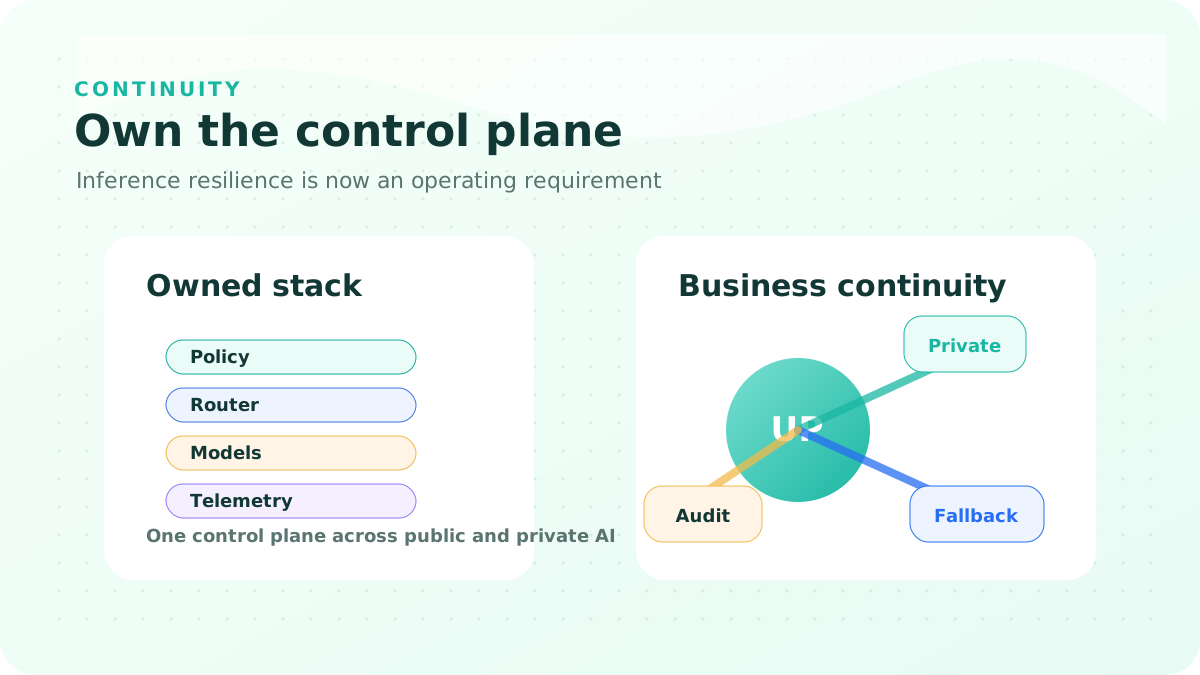
Owning your inference stack does not necessarily mean building models or operating a GPU farm. It means controlling routing, deployment options, cost attribution, failover logic, and the workflows that depend on inference — so policy, price, or provider changes do not halt operations.
Four forces converging in the Middle East
Model access volatility. Export control directives can suspend specific model tiers overnight. Anthropic's Fable 5 and Mythos 5 suspension affected all customers globally. Regional sales restrictions further narrow who may access frontier APIs based on ownership structure. For GCC conglomerates with complex corporate trees, due diligence is now an access requirement.
Token economics at scale. Stanford HAI's 2025 AI Index Report documents dramatic per-token price declines, yet enterprise aggregate spend rises with volume, agents, and long context. Industry analyses commonly cite inference as roughly 80% of production AI cost. Without ownership of routing and observability, finance discovers runaway spend after budgets are committed.
Data sovereignty and sector rules. Saudi localization requirements, UAE federal data protection law, and CBUAE AI guidance for financial institutions create conditions where inference location and model choice are compliance variables. A stack you do not control is a stack you cannot attest to regulators.
Workflow dependency. AI that does not complete governed workflows is expendable. AI embedded in loan approvals, government service cases, and procurement chains is critical infrastructure. Continuity planning must cover both inference availability and Workhall-style process orchestration.
What "owning the inference stack" actually means
Ownership is a control model, not a capex mandate.
| Control domain | Rented default | Owned posture |
|---|---|---|
| Model selection | One vendor default | Tiered routing by task, cost, and sensitivity |
| Deployment | Public API only | Private, hybrid, and sovereign options |
| Failover | Manual re-architecture | Pre-tested alternate model paths |
| Cost | Monthly invoice surprise | Per-workflow attribution and caps |
| Compliance | Opaque subprocessor chain | Documented processing location and audit logs |
| Workflow coupling | Chat interface | Governed approvals and case closure |
Cogniware.ai is the technical foundation for that owned posture. It provides intelligent routing across approved models, optimization of token consumption, private and hybrid deployment for sensitive workloads, and observability that finance and risk teams can audit.
Workhall completes the continuity picture at the process layer. If inference fails over to an alternate model, the approval workflow, human review step, and audit record persist unchanged. Business continuity is end-to-end — not just API uptime.
Why GCC enterprises cannot defer this
National AI programs assume continuity. Saudi Arabia's partnerships with Google Cloud, HUMAIN, and Qualcomm target sovereign capacity. The UAE's Stargate and G42 infrastructure investments pursue long-term compute security. These are national-level ownership strategies.
Enterprise organizations that remain on single-API architectures undermine those investments. National capacity exists, but the organization's workflows cannot use it without a routing and governance layer.
Regulated sectors amplify urgency. The UAE Central Bank expects kill-switch capability for AI systems used by licensed financial institutions. Export control suspension is a real-world kill-switch event. Organizations without alternate inference paths and stable workflow orchestration fail the test regulators are implicitly setting.
Gartner's forecast that 40% of enterprise applications will include task-specific AI agents by 2026 increases dependency density. More agents means more inference calls, more provider exposure, and more processes that halt when a model disappears.
What this means for leaders
- Classify AI-enabled workflows by criticality tier — Tier 1 workflows require owned inference with documented failover.
- Separate inference routing from workflow logic so either layer can change independently.
- Budget for observability and routing infrastructure alongside model API licenses.
- Treat export control, vendor terms, and PDPL as continuity inputs in architecture review.
- Report inference concentration risk to the board with the same rigor as core banking vendor risk.
Practical action checklist
- Define business continuity requirements for every Tier 1 AI-enabled workflow.
- Deploy Cogniware.ai with multi-model routing, private deployment options, and per-workflow cost tracking.
- Implement Workhall governance for Tier 1 workflows — human review, audit trails, kill-switch procedures.
- Pre-approve and retest fallback models; run semi-annual suspension simulations.
- Map inference processing locations against PDPL and sector data rules.
- Cap agentic pipeline depth — limit model calls per completed outcome.
- Review inference stack ownership quarterly with technology, risk, finance, and operations jointly.
Continuity is the new AI maturity test
The organizations that treated AI as a chatbot experiment will absorb the next model suspension as a crisis. Those that own their inference stack — routing, deployment, economics, and workflow integration — will absorb it as a failover event.
That is the maturity gap in the GCC market in 2026. National infrastructure is advancing. Enterprise architecture must catch up.
Cogniware.ai makes private, optimized, multi-model inference practical. Workhall ensures the workflows that depend on inference keep running with governance intact. Together, they form the continuity architecture Middle East enterprises need.
in-box.ai delivers both as part of its enterprise AI and automation practice for organizations that require production resilience, not pilot fragility.
Sources used
- Anthropic — Fable 5 and Mythos 5 access suspension under US export control directive (June 2026)
- Anthropic — Updating restrictions of sales to unsupported regions (September 2025)
- BIS — AI Diffusion Rule rescission and strengthened chip controls (May 2025)
- Stanford HAI — 2025 AI Index Report (inference cost trends)
- Mirantis — Inference economics and production cost split
- Gartner — 40%+ agentic AI projects canceled by end of 2027
- Gartner — 40% of enterprise apps with task-specific AI agents by 2026
- Crowell & Moring — GCC sovereign AI infrastructure investments
- CBUAE — AI/ML Guidance for licensed financial institutions (February 2026)
- SDAIA — Saudi Personal Data Protection Law
AI briefings
Get the next practical AI and automation briefing
Practical notes on workflow automation, AI infrastructure economics, and governed AI adoption across the Middle East.