
Enterprise AI spending is rising fast. Menlo Ventures estimated $13.8 billion in enterprise generative AI spend in 2024. Gartner forecasts MENA IT spending will reach $169 billion in 2026. Saudi Arabia's AI investment alone is projected to surpass $800 million in 2025.
Failure rates are rising in parallel. MIT NANDA research found roughly 95% of generative AI pilots deliver little to no measurable P&L impact. Gartner predicts at least 30% of generative AI projects will be abandoned after proof of concept. A RAND Corporation research report cited in industry analysis notes AI projects fail at roughly twice the rate of non-AI IT projects. Gartner surveys indicate only about 48% of AI projects reach production, averaging eight months from prototype to deployment.
For Middle East banks processing millions of transactions and government entities serving citizens under national transformation mandates, the waste is not experimental budget. It is duplicated pilots, orphaned copilots, unconstrained API bills, and manual workflows that AI was supposed to replace but did not.
Where the money goes — and why it does not return
Broken AI workflows share a spending pattern.
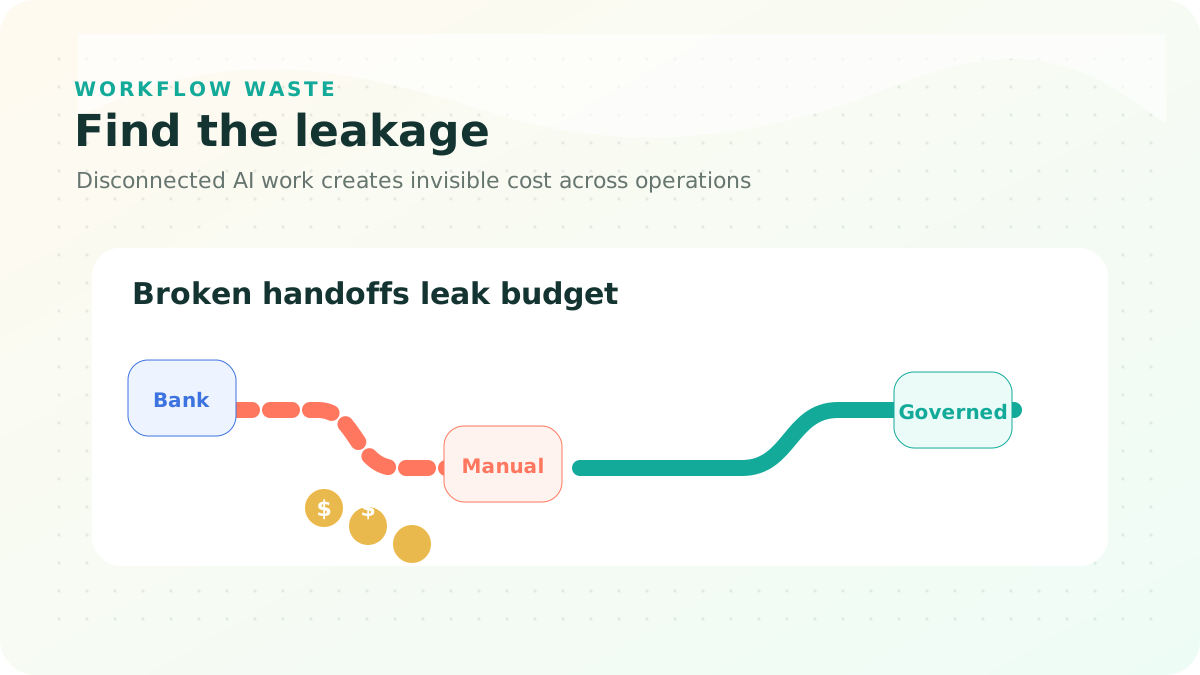
License and API accumulation. Departments procure copilots, document AI tools, and agent platforms independently. Finance sees growing recurring spend. Operations sees unchanged cycle times because outputs never enter case management or approval systems.
Integration debt. Internal AI builds — common in financial services — succeed roughly one-third as often as specialized workflow-integrated implementations, per MIT's findings. Failed builds leave sunk engineering cost and no production asset.
Inference runaway. Industry analyses attribute roughly 80% of production AI cost to inference. Agentic designs that chain multiple model calls per customer query or government service request multiply spend without completing a single governed workflow step.
Compliance rework. The UAE Central Bank's February 2026 AI/ML guidance and Qatar's mandatory bank AI guidelines expect inventories, bias testing, human review, and kill-switch capability. Pilots built without those controls require expensive retrofitting — or abandonment.
The result is millions spent across the GCC on capabilities that generate text but do not close cases, approve loans, or resolve citizen requests inside auditable processes.
Why banks and government entities feel this first
Regulated institutions face the highest workflow complexity and the lowest tolerance for unaudited automation.
Banking. Credit exceptions, AML reviews, claims adjudication, and KYC remediation require documented human decisions. A chatbot that drafts a summary but leaves the approval in email adds AI cost without reducing operational risk.
Government. National digital government strategies and Vision 2030-aligned programs measure service time, digital adoption, and cost per transaction. AI demos that do not connect to permit workflows, benefits processing, or inter-agency approvals fail public value tests.
Shared services. HR onboarding, procurement, and vendor management span entities with different data rules. Broken workflows here duplicate AI spend across departments while shadow AI proliferates among staff.
These are precisely the environments where MIT found the strongest ROI — back-office and mid-office automation — and where GCC regulators are now focusing supervisory attention.
A shorter path: governed workflows plus controlled inference
Reducing waste requires connecting AI to operations and controlling inference economics. That is the combined value of Workhall and Cogniware.ai.
Workhall for workflow completion
- Digitize approval chains, case routing, and service requests in weeks
- Embed AI-generated outputs as inputs to governed human decisions
- Produce audit trails required by CBUAE-style guidance and government accountability standards
- Eliminate the gap between "AI answered" and "work completed"
Cogniware.ai for inference discipline
- Route tasks to appropriate model tiers — not every step needs a frontier model
- Deploy private or hybrid inference for sensitive banking and government data
- Attribute token spend to departments and use cases
- Maintain failover when model access shifts under export control policy
A loan exception workflow illustrates the model. Cogniware.ai extracts and summarizes applicant data at controlled cost. Workhall routes the case through credit, compliance, and approval hierarchies with timestamps and human sign-off. Finance tracks cost per completed exception. Risk sees a full audit path. The workflow closes — not stalls in an AI chat window.
What this means for leaders
- Stop approving AI spend that does not name the workflow it will complete and the metric it will move.
- Consolidate departmental AI tools; fragmented procurement is a leading source of wasted millions.
- Require Workhall or equivalent governed workflow integration before scaling inference volume.
- Apply Cogniware.ai cost controls before agentic designs enter production.
- Report waste candidly: count abandoned pilots, monthly API overruns, and processes where AI did not reduce cycle time.
Practical action checklist
- Audit all AI spend from the past 18 months; tag each line item with a production workflow or mark it pilot-only.
- Identify top five processes where AI outputs are not connected to case or approval systems.
- Assign a business owner and baseline metric (cycle time, cost per case, error rate) to each remediation target.
- Deploy Workhall applications for the three highest-cost broken workflows within 60 days.
- Layer Cogniware.ai routing and spend caps on all AI calls feeding those workflows.
- Retire redundant copilot licenses where Workhall workflows now complete the same work.
- Present quarterly savings and outcome metrics to risk and transformation committees.
Stop funding fragments. Start funding completions.
The GCC will continue investing in AI at national and enterprise scale. The waste is not inevitable. It is the product of disconnected models, unconstrained inference, and workflows that were never digitized.
Banks and government entities that pair Workhall's governed automation with Cogniware.ai's inference control can shorten delivery cycles, lower recurring cost, and produce the audit evidence regulators and transformation offices require.
in-box.ai works with Middle East organizations to deploy that combined model — practical, secure, and measurable — without multi-year platform replacements.
Sources used
- Fortune — MIT NANDA: 95% of GenAI pilots fail
- Gartner — 30% of GenAI projects abandoned after POC
- Gartner — 48% of AI projects reach production; eight-month timeline (cited via Informatica)
- RAND Corporation — AI project failure rates vs. non-AI IT projects (cited via Informatica)
- Menlo Ventures — Enterprise GenAI spending 2024 (cited via Informatica)
- Gartner — MENA IT spending $169 billion in 2026 (cited via Crowell)
- U.S. International Trade Administration — Saudi Arabia AI spending projections
- CBUAE — AI/ML Guidance Note for licensed financial institutions (February 2026)
- Mirantis — Inference as majority of production AI spend
AI briefings
Get the next practical AI and automation briefing
Practical notes on workflow automation, AI infrastructure economics, and governed AI adoption across the Middle East.