
Most enterprise AI budgets in production go to inference, not training. Industry analyses citing NVIDIA and Epoch AI research commonly describe an approximate 80/20 split — inference consuming the larger share as usage grows. Gartner predicts that over 40% of agentic AI projects will be canceled by the end of 2027, citing unclear value, escalating costs, and inadequate risk controls.
The Stanford HAI 2025 AI Index Report notes that inference cost for GPT-3.5-level capability dropped more than 280-fold between November 2022 and October 2024. That headline is real — and misleading for enterprise leaders. Unit costs fell while aggregate spend rose because organizations multiplied tokens through agents, retrieval-augmented generation, and ever-longer context windows.
In the GCC, where AI adoption in government, banking, and energy is accelerating under national strategies, the pilot-to-production cliff is increasingly a finance problem dressed as a technology problem.
Token economics: why pilots lie
Pilots understate production cost in four predictable ways.
Volume. A proof of concept with 200 users processing 10 requests per day bears no resemblance to 20,000 employees or millions of customer interactions. Inference cost scales linearly with tokens consumed — and super-linearly when agents chain multiple model calls per task.
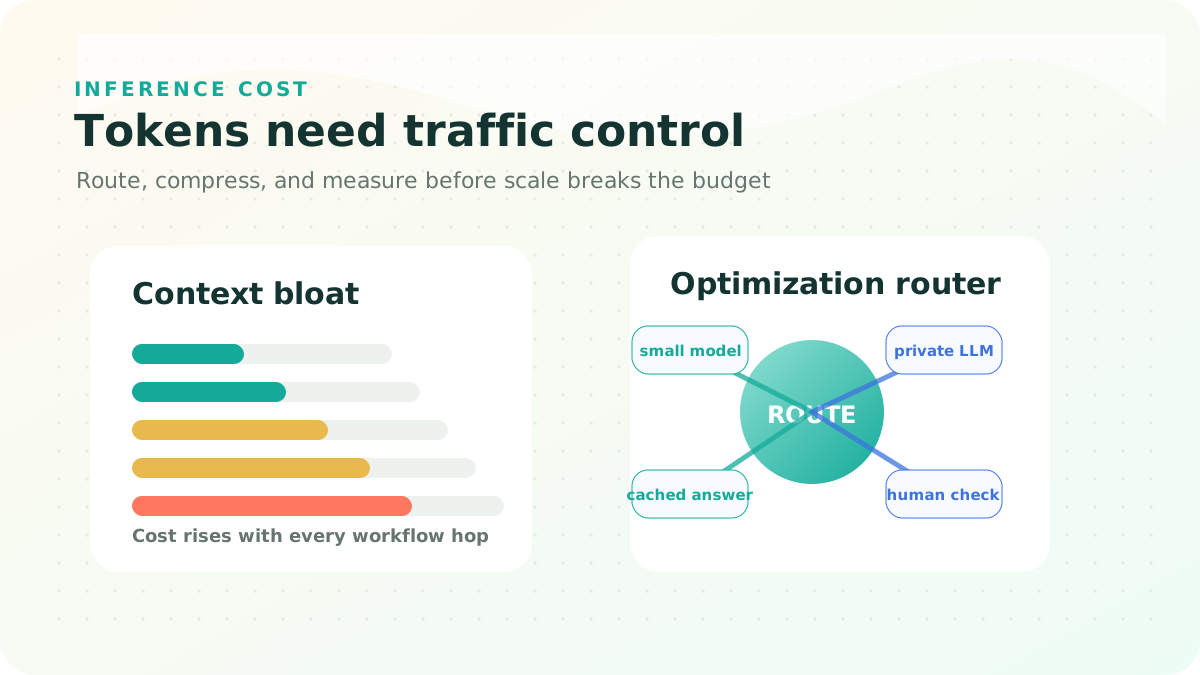
Context bloat. Long-context models enable powerful retrieval workflows, but processing cost grows with input length. Technical analyses note that a 128K-token context can cost substantially more to process than an 8K context for the same query pattern, before output tokens are counted.
Agentic multiplication. A single user request in an agentic workflow may trigger classification, retrieval, reasoning, tool execution, and verification steps — each billable. Gartner forecasts that 40% of enterprise applications will feature task-specific AI agents by 2026, up from less than 5% in 2025. Each agent is a recurring inference pipeline.
Model oversizing. Teams default to frontier models for every task because procurement is simpler. Benchmark analyses indicate that larger models can increase per-token cost by multiples compared to smaller models suited for narrow tasks — a rational tradeoff for complex reasoning, an expensive mistake for classification and extraction.
Pilots rarely model these compounding effects. Finance discovers them after procurement commits to enterprise licenses.
The lab-to-production cost trap in Middle East enterprises
GCC organizations face additional cost pressures beyond token math.
National AI programs encourage rapid rollout across government services and regulated industries. Saudi Arabia's AI spending is projected to surpass $800 million in 2025 and reach $2.1 billion by 2027, according to U.S. Commerce Department analysis citing market research. Demand is real. So is the risk of unconstrained API consumption across ministries, shared services, and vendor ecosystems.
Data residency and sovereign deployment requirements can improve control but do not automatically reduce cost. Private GPU infrastructure carries capital and utilization risk. Organizations that lift-and-shift pilot architectures into sovereign data centers without optimization often pay twice: for hardware and for inefficient inference patterns carried over from the lab.
Gartner's projection that 30% of generative AI projects will be abandoned after proof of concept frequently cites escalating costs alongside poor data quality and unclear value. Cost is the variable leadership can control fastest — if inference is managed as FinOps, not as experimental spend.
Practical levers for inference cost control
Production inference economics require deliberate architecture. Cogniware.ai is designed for this layer of the stack.
Intelligent model routing. Not every task requires a frontier model. Routing simpler workloads to smaller, lower-cost models — whether hosted privately or through approved APIs — reduces average cost per workflow without sacrificing quality on high-stakes steps.
Private and hybrid deployment. For organizations with predictable high-volume workloads, controlled private inference can improve unit economics when GPU utilization is actively managed. Cogniware.ai supports deployment strategies that keep sensitive workloads on sovereign infrastructure while reserving external models for specialized tasks.
Token and context discipline. Caching repeated prefixes, compressing retrieval context, and enforcing maximum context policies per use case are operational controls, not model features. They require observability into per-workflow token consumption — visibility Cogniware.ai provides for finance and engineering alike.
Usage governance. Rate limits, budget caps per department, and chargeback models turn inference from a shared corporate credit card into a managed utility. This is essential in government and banking environments where accountability matters as much as efficiency.
What this means for leaders
- Approve production AI budgets based on cost-per-completed-workflow models, not pilot extrapolations.
- Require architecture review before any agentic workflow enters production; multi-step agents need explicit ROI thresholds.
- Treat inference as the primary FinOps domain for AI, with monthly attribution by business unit and use case.
- Right-size models by task tier; frontier models should be the exception, not the default.
- Pair cost controls with value metrics — Gartner's agentic AI cancellation forecast is as much a value problem as a cost problem.
Practical action checklist
- Instrument all pilot workloads to capture input tokens, output tokens, model tier, and end-to-end latency per transaction.
- Build a three-tier model map: extraction/classification, reasoning, and frontier — with cost caps per tier.
- Model production cost at 10x, 50x, and 100x pilot volume before procurement approval.
- Deploy Cogniware.ai routing to shift eligible workloads to lower-cost or private inference paths.
- Set department-level monthly inference budgets with automated alerts at 70% and 90% thresholds.
- Review agentic workflow designs for redundant model calls; collapse steps where a single pass suffices.
- Report to the board on cost per outcome (case resolved, claim processed, ticket closed), not tokens consumed.
Control inference before it controls the program
Falling per-token prices do not protect organizations from rising total cost. The GCC's production AI wave will be won by teams that treat inference as core infrastructure — measured, routed, optimized, and governed.
Cogniware.ai gives Middle East enterprises the tooling to reduce inference waste through intelligent routing, private deployment options, and the observability finance and technology leaders need to scale with confidence.
in-box.ai delivers Cogniware.ai as part of a broader enterprise AI and automation practice for organizations that need measurable production economics, not perpetual pilots.
Sources used
- Stanford HAI — 2025 AI Index Report
- Mirantis — Optimizing Inference Costs (inference vs. training, token economics)
- Introl — Inference unit economics guide (API pricing tiers, context cost)
- Gartner — 40% of agentic AI projects canceled by end of 2027
- Gartner — 40% of enterprise apps to feature task-specific AI agents by 2026
- Gartner — 30% of GenAI projects abandoned after POC by end of 2025 (cited via Informatica)
- U.S. International Trade Administration — Saudi Arabia Digital Economy (AI spending projections)
AI briefings
Get the next practical AI and automation briefing
Practical notes on workflow automation, AI infrastructure economics, and governed AI adoption across the Middle East.