
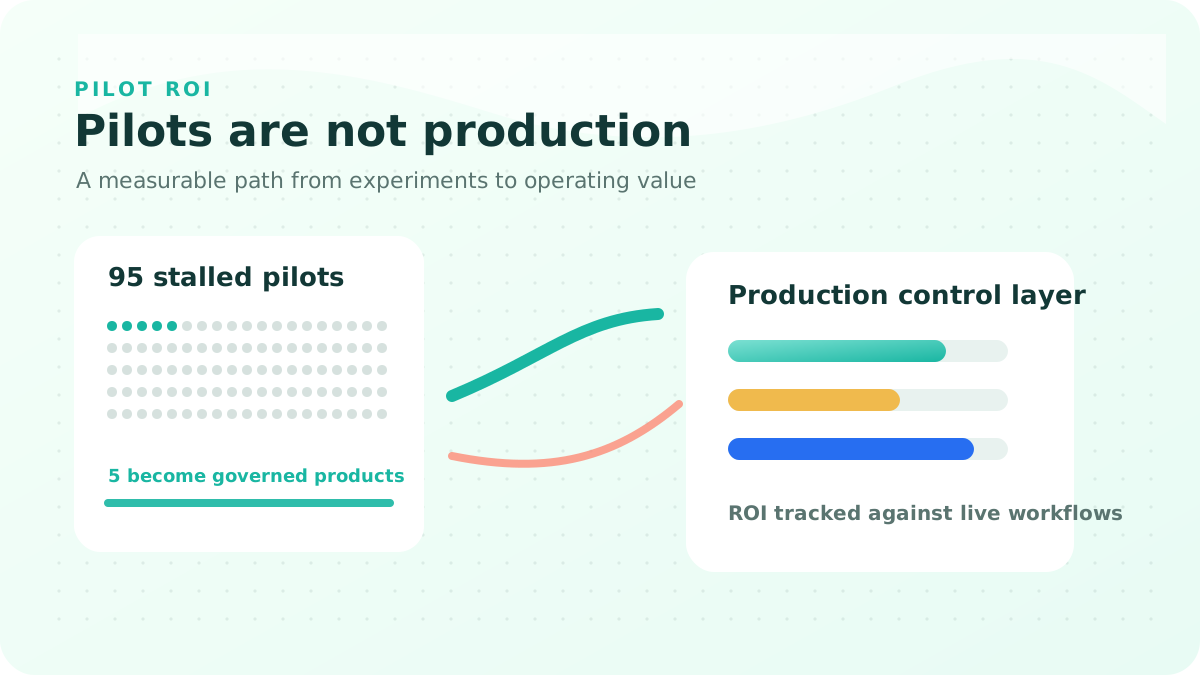
A widely cited MIT NANDA study found that roughly 95% of enterprise generative AI pilots deliver little to no measurable impact on profit and loss, while only about 5% achieve rapid revenue acceleration. Gartner separately predicts that at least 30% of generative AI projects will be abandoned after proof of concept by the end of 2025, citing poor data quality, inadequate risk controls, escalating costs, and unclear business value.
For CIOs and digital transformation leaders across the GCC, these figures are not abstract. Banks, government entities, insurers, and energy companies have spent the past two years funding chatbot pilots, copilot experiments, and innovation sandboxes. Many now face board-level questions about why spend is rising while operational outcomes remain flat.
Why pilots stall in regulated Middle East environments
The MIT research points to an integration problem, not a model quality problem. Generic tools that work for individuals often fail inside enterprises because they do not adapt to workflows, approval chains, or domain-specific controls. In the GCC, that gap is wider. Data localization expectations, sector regulators, and procurement rules mean a standalone pilot rarely survives contact with production governance.
Three patterns repeat across the region:
- Budget misalignment. More than half of generative AI budgets go to sales and marketing pilots, yet MIT found stronger returns in back-office automation — process digitization, outsourcing reduction, and operational efficiency.
- Build-first bias. Internal builds succeed roughly one-third as often as specialized vendor-led implementations focused on workflow fit.
- Shadow AI. Employees adopt unsanctioned tools while official programs remain disconnected from line-of-business systems.
Saudi Arabia, the UAE, and Qatar are not slowing AI investment. Gartner forecasts MENA IT spending will reach $169 billion in 2026. The question is no longer whether to adopt AI, but how to convert pilots into governed production systems that finance, risk, and operations teams can measure.
The production gap: inference cost and workflow disconnect
Two structural barriers keep Middle East pilots in the lab.
First, inference economics change at scale. Industry analyses commonly cite an 80/20 split between inference and training spend in production environments. Agentic workflows, long context windows, and multi-step reasoning multiply token consumption. A pilot that costs little at 500 users becomes unsustainable at 50,000 without routing, caching, and model selection discipline.
Second, AI without workflow integration produces demos, not outcomes. Approvals, case management, document routing, and audit trails remain in email, spreadsheets, and legacy BPM tools. The model generates text. The business process does not change.
A practical path: optimize inference, integrate workflows
Production-scale AI in the GCC requires two capabilities working together.
Controlled inference through Cogniware.ai. Organizations need the ability to route workloads across private, hybrid, and approved cloud models; right-size model selection by task; and monitor token economics before costs reach the CFO. Sovereign and sector-specific requirements in Saudi Arabia and the UAE make single-vendor API dependency a strategic risk, not only a technical one.
Workflow automation through Workhall. The highest-ROI use cases identified in MIT's research sit where AI meets operational process — claims handling, procurement approvals, compliance review, employee onboarding, and government service delivery. Workhall enables no-code business applications, approval chains, and digitized processes that can embed AI outputs inside governed workflows rather than beside them.
The combination addresses both sides of the pilot graveyard: cost control at the inference layer and measurable process change at the operations layer.
What this means for leaders
- Treat pilot success criteria as production criteria from day one: cycle time reduction, error rate, cost per transaction, and auditability — not demo quality.
- Shift investment toward back-office and mid-office automation where regulatory value and ROI concentration are highest.
- Mandate workflow integration before scaling token spend; a copilot without a process owner is a recurring cost.
- Build hybrid AI architecture now, before the next model access or export control disruption forces a reactive migration.
- Assign joint ownership to technology, operations, and risk — not to a central AI lab operating in isolation.
Practical action checklist
- Inventory all GenAI pilots and classify each by workflow integration depth and inference cost trajectory.
- Kill or consolidate pilots with no named process owner, no baseline metrics, and no path to production governance.
- Map data residency, PDPL, and sector guidance requirements before selecting inference deployment models.
- Implement model routing and usage monitoring before expanding user counts beyond the pilot cohort.
- Pair each production candidate with a Workhall workflow or approval application that defines human-in-the-loop controls.
- Report monthly on cost per completed workflow, not cost per token or per user license.
- Review vendor and model concentration risk quarterly against export control and geopolitical developments.
Moving from experimentation to accountable scale
The Middle East's AI ambition is real and backed by national strategies, data center investment, and regulator attention. The organizations that convert that ambition into value will not be those with the most pilots. They will be those that operationalize AI inside controlled, measurable workflows with inference economics under management.
in-box.ai helps GCC enterprises make that transition through Cogniware.ai for optimized, sovereign-ready inference and Workhall for workflow automation that connects AI outputs to the processes boards actually care about.
Sources used
- Fortune — MIT report: 95% of generative AI pilots at companies are failing
- MIT NANDA — The GenAI Divide: State of AI in Business 2025 (report access)
- Gartner — 30% of generative AI projects abandoned after proof of concept by end of 2025 (cited via Informatica analysis)
- Gartner — MENA IT spending forecast $169 billion in 2026 (cited via Crowell client alert)
- Crowell & Moring — The Middle East's Big Bet on Artificial Intelligence and Data Security
- Mirantis — Optimizing Inference Costs (inference vs. training economics)
AI briefings
Get the next practical AI and automation briefing
Practical notes on workflow automation, AI infrastructure economics, and governed AI adoption across the Middle East.