
Saudi Arabia announced a $40 billion AI investment fund in 2024. Google Cloud and Saudi Arabia's Public Investment Fund advanced a $10 billion partnership to build an AI hub in the Kingdom. The UAE's Stargate initiative, backed by OpenAI, NVIDIA, and G42, signals intent to position Abu Dhabi as a major AI infrastructure node. Gartner forecasts MENA IT spending will reach $169 billion in 2026.
At the same time, the rules of the game are tightening. Saudi Arabia's Personal Data Protection Law imposes strict data localization for personal data. The U.S. Commerce Department rescinded the Biden-era AI Diffusion Rule in May 2025 while strengthening chip-related export controls and issuing guidance on AI model weight diffusion. Anthropic updated regional sales restrictions in September 2025, citing national security and ownership-structure risks.
For enterprise leaders in banking, government, energy, and healthcare across the GCC, sovereign AI is no longer a national policy headline. It is an infrastructure and procurement decision with direct operational consequences.
National ambition meets enterprise reality
Gulf states are building data centers, sovereign cloud regions, and AI governance frameworks in parallel. Crowell & Moring's 2025 analysis documents multi-billion-dollar partnerships involving HUMAIN, G42, MGX, and global hyperscalers, alongside national AI strategies in Saudi Arabia, the UAE, and Qatar.
National capacity, however, does not automatically translate into enterprise readiness. Most large organizations still depend on a mix of:
- Public cloud APIs for frontier models
- Legacy on-premises systems for core banking and ERP
- Sector-specific free-zone regulations (DIFC, ADGM, QFC) layered on federal data protection law
- Procurement rules that increasingly reference AI ethics, bias testing, and human oversight
The result is architectural fragmentation. Data may need to remain in-Kingdom or in-Emirate while inference may run on infrastructure subject to foreign export control policy. Workflows may span regulated financial entities and shared service centers with different legal bases for processing.
Data sovereignty is a workflow problem, not only a data center problem
Saudi PDPL localization requirements and UAE federal data protection law create conditions where cross-border transfers require explicit legal bases and, in some cases, regulatory approval. Qatar's central bank has issued mandatory AI guidelines for licensed financial institutions requiring governance frameworks and prior approval for high-risk systems.
Organizations that treat sovereignty as "where the GPU sits" miss the harder question: where does inference occur, what data crosses the boundary, and who can audit the path?
Three sovereignty decisions now sit on every enterprise AI roadmap:
- Compute location — private, sovereign cloud, hybrid, or foreign-hosted API
- Model provenance — open-weight, licensed frontier, or locally fine-tuned
- Workflow jurisdiction — which steps require human approval, Arabic/English disclosure, and kill-switch capability under emerging financial sector guidance
Without alignment across all three, compliance exposure grows even when the data center is local.
Export controls add strategic uncertainty
The U.S. Bureau of Industry and Security rescinded the AI Diffusion Rule in May 2025 but simultaneously issued guidance warning industry about risks of advanced computing IC diversion and use of U.S. AI chips for training Chinese AI models. The January 2025 Framework for Artificial Intelligence Diffusion Rule had proposed tiered country access to advanced AI models and computing — a signal that model and chip access can change with geopolitical posture.
For GCC enterprises, the lesson is not to avoid U.S. technology. It is to avoid single-path dependency. When model access, chip supply, or API terms shift, organizations without hybrid routing and portable workflows absorb the full disruption cost.
Building sovereign-ready architecture
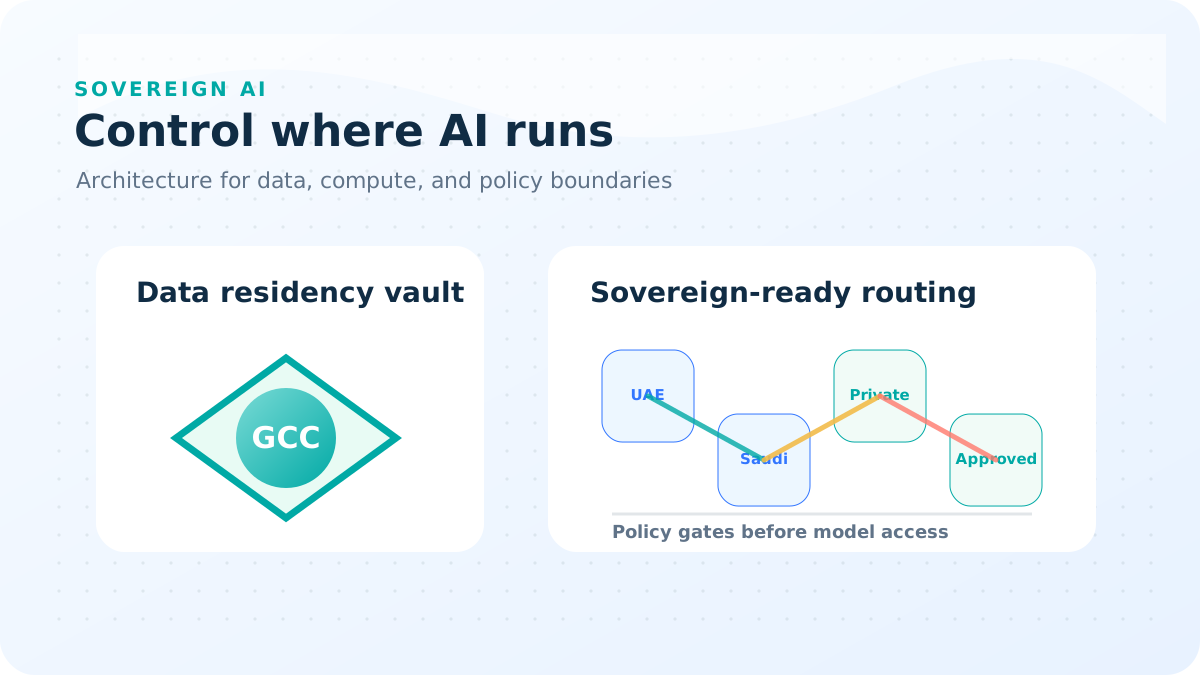
Cogniware.ai addresses the inference and routing layer. It enables controlled deployment across private and hybrid environments, model routing based on task sensitivity and cost, and optimization of token consumption so sovereign infrastructure is not wasted on low-value workloads. For organizations balancing HUMAIN, G42, hyperscaler regions, and on-premises GPU capacity, that routing layer is the difference between flexibility and lock-in.
Workhall addresses the compliance workflow layer. Regulators across the GCC increasingly expect AI model inventories, approval chains, human review of high-impact decisions, and documented process controls. Workhall's no-code applications and approval workflows let organizations embed those controls without eighteen-month custom development cycles — and without binding process logic to a single AI vendor's ecosystem.
Together, they support an operating model where sensitive inference stays controlled, operational workflows stay portable, and model providers can change without rewriting the business process.
What this means for leaders
- Sovereign AI strategy must be owned jointly by infrastructure, data protection, and business operations — not delegated to a single cloud contract.
- Evaluate every AI initiative against data localization, cross-border transfer, and sector-specific guidance before scaling beyond pilot.
- Treat export control and model-access policy as continuity risks, equivalent to supplier concentration in core banking systems.
- Prefer architectures that separate workflow logic from model provider so regulatory or geopolitical change triggers rerouting, not re-platforming.
- Invest in audit trails and human-in-the-loop controls now; financial sector guidance in the UAE and Qatar is moving from principles to supervisory expectation.
Practical action checklist
- Map all AI workloads by data classification, residency requirement, and current inference location.
- Document model provider concentration and identify single points of failure in chip, API, and weight access.
- Define tiered inference policy: which tasks require private/sovereign compute vs. approved shared services.
- Implement hybrid model routing with cost and policy-based selection before Q4 budget cycles.
- Build Workhall approval workflows for high-risk AI decisions with named human owners and kill-switch procedures.
- Align AI governance documentation with PDPL, sector regulator, and procurement ethics requirements.
- Review architecture quarterly against BIS export control updates and provider terms-of-service changes.
Sovereignty as operational discipline
GCC governments are spending at national scale to secure AI capacity and talent. Enterprise organizations that match that ambition with controlled inference and compliant workflow automation will be positioned to use sovereign infrastructure rather than be constrained by it.
in-box.ai supports sovereign-ready enterprise AI delivery across the Middle East through Cogniware.ai for optimized hybrid inference and Workhall for governed process automation that satisfies operational and regulatory scrutiny.
Sources used
- Crowell & Moring — The Middle East's Big Bet on Artificial Intelligence and Data Security
- Gartner — MENA IT spending forecast $169 billion in 2026 (cited via Crowell)
- DIG.WATCH — Saudi Arabia $40 billion AI fund
- Google Cloud — PIF Advance AI Hub in Saudi Arabia ($10 billion partnership)
- OpenAI — Introducing Stargate UAE
- BIS — Rescission of AI Diffusion Rule and strengthened chip export controls (May 2025)
- Federal Register — Framework for Artificial Intelligence Diffusion (January 2025)
- Anthropic — Updating restrictions of sales to unsupported regions (September 2025)
- Law Library of Congress — FALQs: AI Regulations in GCC Member States
AI briefings
Get the next practical AI and automation briefing
Practical notes on workflow automation, AI infrastructure economics, and governed AI adoption across the Middle East.