
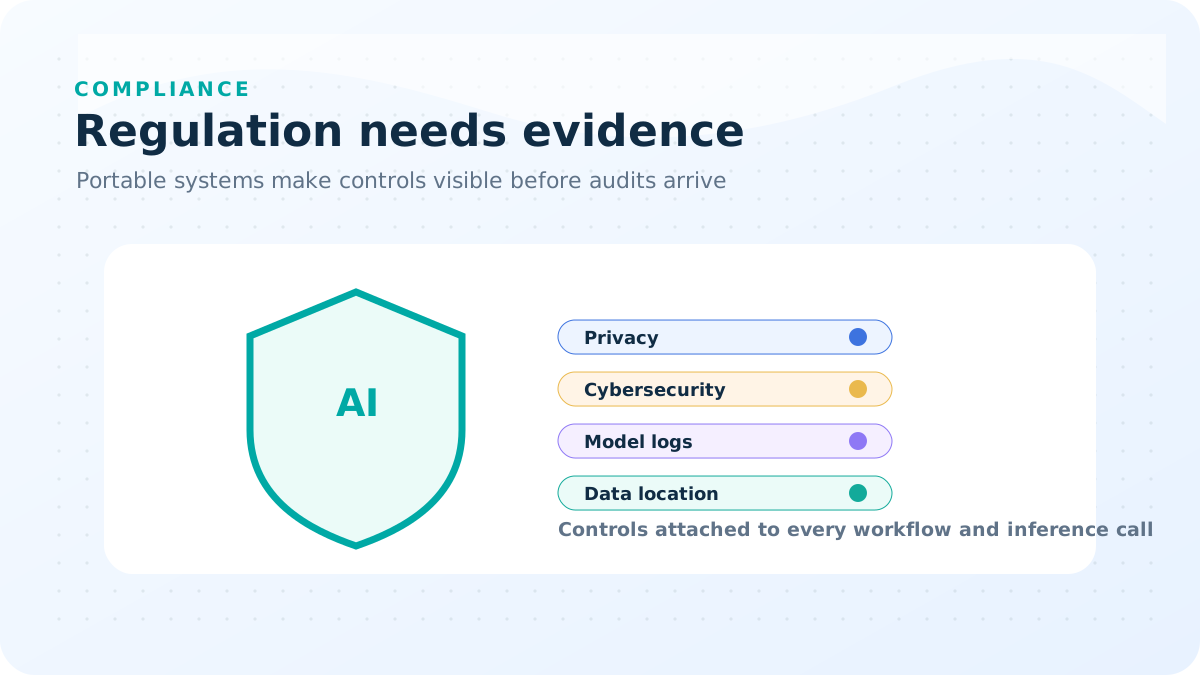
The GCC regulatory environment for AI and data is no longer a future consideration. It is an active procurement and architecture filter.
In February 2026, the UAE Central Bank published a Guidance Note on responsible adoption of AI and machine learning for all licensed financial institutions — covering board accountability, model inventories, bias testing, consumer opt-out rights, human review, and kill-switch capability. Saudi Arabia's Personal Data Protection Law imposes data localization requirements with fines up to SAR 5 million for violations. Qatar's central bank issued mandatory AI guidelines for banks in September 2024. Bahrain's Shura Council approved a 38-article standalone AI regulation law in April 2024, with proposed criminal penalties for certain violations.
Across the region, governments are pairing AI investment with oversight. Organizations whose platforms cannot adapt to evolving rules face delayed launches, supervisory findings, and tender disqualification — not merely legal advisory fees.
Regulatory acceleration across the Gulf
Three trends define the 2026 compliance landscape.
From principles to supervisory expectation. The UAE Charter for AI Development (June 2024) and Saudi SDAIA AI Ethics Principles are non-binding — but sector regulators are translating principles into actionable guidance. The CBUAE's February 2026 guidance uses "should" language but carries strong supervisory weight for banks, insurers, exchange houses, and payment providers.
Data protection as AI gatekeeper. Saudi PDPL, UAE Federal Decree-Law No. 45/2021, and Qatar's 2016 personal data privacy law establish rights, transfer conditions, and enforcement mechanisms that directly constrain AI training and inference on personal data. Saudi localization requirements mean cloud-first AI architectures designed for other regions may require structural change.
Free-zone complexity. DIFC Regulation 10 was among the first Middle East rules explicitly addressing autonomous AI systems. ADGM and QFC maintain separate frameworks. Multinational banks operating across mainland and free-zone entities face concurrent obligations — a single global AI platform rarely maps cleanly.
The Law Library of Congress notes that GCC states are adopting "soft law" ethics frameworks alongside harder data protection statutes, with Bahrain moving toward comprehensive AI legislation. The direction is toward more rules, more sector specificity, and more enforcement attention — not less.
How platforms create exposure
Most enterprise AI stacks were procured for capability, not portability. That creates four exposure points as GCC rules mature.
Model-vendor coupling. When workflow logic, audit logs, and model endpoints are embedded in a single SaaS copilot, changing providers — or complying with a kill-switch directive — requires re-implementing business processes.
Opaque inference paths. Regulators increasingly expect organizations to know which models process which data, under what legal basis, and with what human oversight. Undocumented API chains across multiple subprocessors fail that test.
Static BPM. Legacy BPM suites that require developer-led changes cannot keep pace with quarterly guidance updates from central banks and data authorities.
Missing AI inventories. CBUAE guidance expects licensed financial institutions to maintain AI model inventories with purpose and risk rating. Platforms that do not expose model metadata and usage logs force manual shadow tracking.
Exposure is not theoretical. It manifests as blocked go-lives, remediation projects, and inability to bid on government contracts requiring ethics self-assessments and documented governance.
Building compliant, portable systems
Compliance-ready architecture separates three concerns: where inference runs, how workflows are governed, and where data is processed. Cogniware.ai and Workhall address each layer without locking organizations to a single hyperscaler.
Cogniware.ai for sovereign, auditable inference
- Route workloads across private, hybrid, and approved cloud models based on data classification
- Maintain visibility into model version, token usage, and processing location
- Support failover when model access changes under export control or vendor policy
- Optimize inference cost so compliance-driven private deployment remains economically sustainable
Workhall for governed workflow automation
- Build no-code approval and case management applications with audit trails
- Implement human-in-the-loop review for high-impact AI-assisted decisions
- Configure kill-switch and escalation workflows aligned to CBUAE and similar supervisory guidance
- Adapt process logic quickly when regulatory requirements change — without multi-month development cycles
Portability matters because GCC rules will continue evolving. Saudi Arabia expects a dedicated AI law within the next several years. Bahrain's AI law remains under parliamentary review. Organizations need platforms that adapt faster than legislation cycles.
What this means for leaders
- Treat AI platform procurement as a regulatory compliance decision, not only a capability purchase.
- Require model inventory, audit trail, and data processing documentation from every AI vendor before production approval.
- Prefer architectures that separate Workhall workflow governance from Cogniware.ai inference routing — so either layer can change without re-platforming the other.
- Engage legal, data protection, and sector compliance teams at architecture stage — not after pilot success.
- Do not claim "fully compliant" status; build demonstrable controls and document continuous alignment efforts.
Practical action checklist
- Conduct a regulatory mapping workshop covering every jurisdiction and free zone where AI processes data.
- Build an AI system inventory with model name, purpose, risk tier, data categories, and inference location.
- Review current platforms for vendor lock-in, undocumented subprocessors, and missing audit logs.
- Deploy Workhall workflows with human review and kill-switch paths for all high-impact AI use cases.
- Implement Cogniware.ai routing policies that enforce data classification rules before inference executes.
- Align documentation with ISO 42001-style governance practices referenced by SDAIA and regional regulators.
- Schedule quarterly compliance architecture reviews against new CBUAE, SDAIA, and PDPL guidance.
Compliance is architecture, not paperwork
GCC regulators are not anti-AI. They are anti-unaccountable AI. National strategies from Riyadh to Abu Dhabi assume AI will transform government and industry — under documented governance, human oversight, and data protection.
Organizations whose platforms cannot support those requirements will be left with expensive pilots and blocked production paths. Those that build portable, governed systems now will be positioned to scale as rules mature.
in-box.ai helps Middle East enterprises deploy Cogniware.ai for sovereign-aware inference optimization and Workhall for compliant workflow automation — designed for measurable delivery under regional regulatory scrutiny.
Sources used
- CBUAE Rulebook — Guidance Note on responsible adoption and use of AI/ML (February 2026)
- Law Library of Congress — FALQs: AI Regulations in GCC Member States
- Crowell & Moring — Middle East data protection and AI governance frameworks
- SDAIA — Personal Data Protection Law (Saudi Arabia)
- UAE Legislation — Federal PDPL (Decree-Law 45/2021)
- Qatar Central Bank — AI Guidelines for licensed financial institutions (September 2024)
- DIFC — Regulation 10 amending data protection for autonomous AI systems
- UAE — Charter for the Development and Use of AI (June 2024)
AI briefings
Get the next practical AI and automation briefing
Practical notes on workflow automation, AI infrastructure economics, and governed AI adoption across the Middle East.