
Anthropic's withdrawal of Fable 5 and Mythos 5 after a U.S. government export control directive should make every enterprise ask a serious question:
Who really controls your AI infrastructure, and can you afford to cede that control?
Frontier models are powerful. They will remain an important part of the enterprise AI stack. For hard reasoning, long-horizon agents, complex coding, and broad general-purpose work, hosted frontier models can be extremely valuable.
But if your AI strategy depends entirely on hosted models from a small number of frontier labs, you are accepting operational risks that become harder to ignore as AI moves from experimentation into production.
AI is becoming part of how businesses serve customers, write software, review contracts, monitor security, support employees, and run core workflows. When AI becomes business infrastructure, control matters.
Here are six risks enterprises should take seriously.
1. Government and regulatory risk
AI models are now strategic assets.
Anthropic's own statement said the U.S. government directive required the company to suspend access to Fable 5 and Mythos 5 for foreign nationals, which led Anthropic to disable both models for customers to ensure compliance.
That is a clear reminder that access to advanced AI can be affected by export controls, procurement restrictions, national security reviews, and government policy.
This risk does not stop with government agencies. It can affect contractors, regulated industries, partners, customers, and entire supply chains. A model you can use today may become unavailable tomorrow, even if your own business has done nothing wrong.
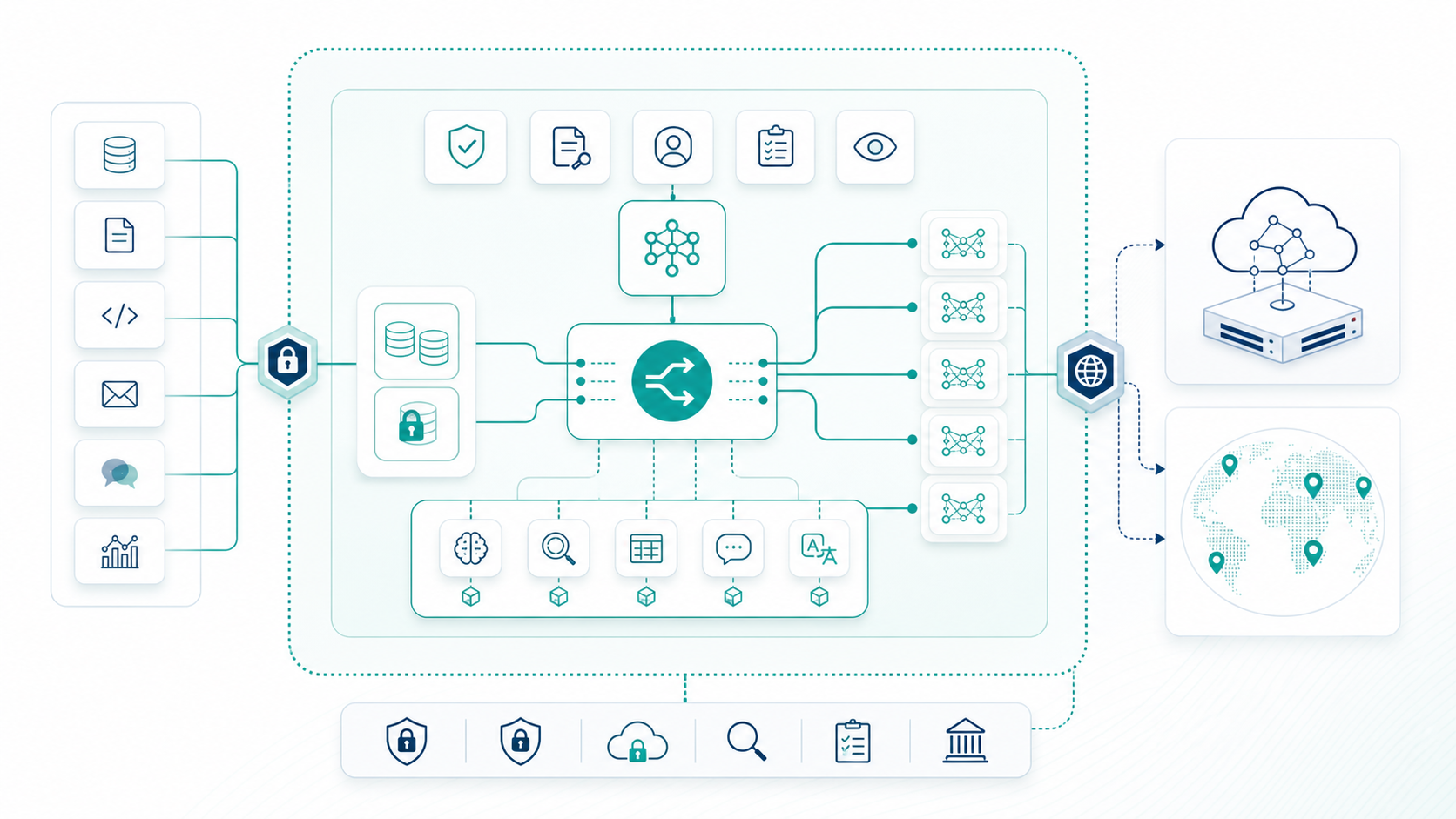
Enterprises need architectures that can absorb this kind of shock. That means keeping the ability to route work across models, operate approved models in controlled environments, and avoid turning one hosted endpoint into a single point of failure.
2. Token economics
Modern agentic workflows generate a lot of tokens.
Context accumulates. Agents plan, call tools, critique outputs, retrieve documents, delegate subtasks, and call other models. A workflow that looks cheap in a prototype can become expensive when it runs every day across departments.
The issue is not that frontier models are too expensive for all work. The issue is that not every task needs a premium general-purpose model.
Classification, extraction, routing, summarization, document cleanup, policy checks, search augmentation, and domain-specific assistance can often be handled by smaller models or specialized systems operated under your own control.
Owning more of your inference layer lets you match the model to the task instead of sending every step to the most expensive option by default.
3. Data security
Enterprise AI runs on context.
That context can include customer records, source code, contracts, pricing, security telemetry, financial data, support histories, internal policies, employee information, and operational knowledge.
Some of that context can safely be sent to a hosted frontier model under the right agreements and controls. Some of it should not leave your boundary at all.
Enterprises need a clear architecture for deciding which workloads can use external models, which workloads require private inference, and which data should be masked, minimized, or kept entirely inside the organization.
The more AI becomes embedded in daily operations, the more important that boundary becomes.
4. Vendor risk
Frontier labs are not neutral utilities. They are businesses with their own strategies, investors, policy pressures, capacity limits, and product roadmaps.
A provider can change pricing, rate limits, model availability, data policies, safety behavior, supported regions, or commercial terms. It can prioritize larger customers. It can deprecate a model your workflows depend on. It can shift focus toward a product direction that no longer matches your architecture.
None of this means enterprises should avoid frontier labs. It means they should avoid depending on any one provider as the whole AI strategy.
Model choice should be an architectural decision, not a dependency trap.
5. Model ownership
The real opportunity in enterprise AI is not simply using the same models as everyone else.
The bigger opportunity is building AI systems that understand your products, customers, controls, workflows, risk language, internal tools, and institutional knowledge.
That learning curve should compound inside your company.
If every improvement lives only in prompts wrapped around someone else's hosted model, your organization may be renting intelligence rather than building capability. Owning more of the inference stack gives you more room to tune, evaluate, optimize, specialize, and preserve what your business learns.
This does not always require training a giant model from scratch. It can mean private deployment, model distillation, fine-tuning, retrieval design, evaluation pipelines, policy-aware routing, and smaller specialized models that become increasingly valuable over time.
6. Data sovereignty
Countries are tightening rules around where AI runs, where data lives, which entities can process sensitive information, and who captures the economic value created by AI systems.
Requirements will not become simpler. They will fragment by jurisdiction, sector, customer type, and data classification.
Enterprises that build for model independence now will have more options later. They can decide where inference runs, which data stays local, which models are approved for which markets, and how to comply when rules change.
Data sovereignty is not only a legal concern. It is a business continuity concern.
The right answer is hybrid control
Owning your inference does not mean rejecting frontier models.
It means building an AI architecture where frontier models are one powerful part of the stack, not the whole stack.
A mature enterprise AI strategy should be able to use hosted frontier models where they are the best fit, private or sovereign models where control matters, specialized models where economics matter, and routing logic that decides intelligently between them.
That is how enterprises get the benefits of modern AI without surrendering control of architecture, costs, sensitive data, or long-term capability.
Cogniware.ai's mission is to make owning your inference cost-effective, high-performance, secure, and simple.
The companies that build for control now will have more freedom as AI becomes the lifeblood of modern business.
AI briefings
Get the next practical AI and automation briefing
Practical notes on workflow automation, AI infrastructure economics, and governed AI adoption across the Middle East.